In this week’s Torah class we went back and studied Chapter 3 of Yirmiya with numerous commentaries. It’s filled with a mix of mussar, prophecies about the redemption, and the simple formula to bring it (including the actual words Hashem tells us to say). Maybe instead of spinning our wheels we should have a group meeting and do it already.
One of the biggest problems of this confused generation is that kofrim,reshaim, azei panim, and intellectually dishonest ideologues set the discourse, instead of yirei shamayim, tzaddikim, and humble, emesdik talmidei chachamim.
That’s why we are bombarded with cynical rhetoric about milchemes mitzvafrom people who are lax about much of the rest of the Torah as a lechatchila. Oh, they can cherry-pick a pasuk, make a slogan out of it, and act as if that’s all there is to say on the subject. How impressive! How profound! They can even hijack a line from the Rambam, as if they are such ardent followers of the Rambam, and the Rambam would consider them inside the pale.
These are the sort of people who travel the world seeking pleasure and gluttony, noting that Rav Hirsch wanted to see the Alps to admire Hashem’s creation. How pious! They can’t tell you anything else Rav Hirsch said, and certainly don’t share his zealotry against those who “reform” the Torah, but when it comes to globetrotting they are faithful disciples of Rav Hirsch. Never mind that they aren’t stuffing their minds with Torah like Rav Hirsch, admiring that aspect of Hashem’s creation first and foremost, before stuffing their bellies and making sure they see exotic faraway places, for purely spiritual reasons, of course.
How many people stop and consider what the Torah has to say beforemaking up their minds, instead of working backwards to hijack a source after the fact? How many people clear their minds before studying Torah, recognize that they are about to interface with divine wisdom, with God’s objective truth, and humbly prepare to adjust their pre-existing views accordingly?
From my anecdotal experience, not many. Most people aren’t grounded — and I’m talking about “frum” people. They’re just doing what they do, and lying to themselves about why they are really doing it. They have an abusive relationship with the Torah, whereby they magnify the sources they like and dismiss or explain away the sources they don’t. For them Torah study is not sacred, but a game, a text to be exploited in whatever manner suits them. Chazal and Gedolim are to be respected when it suits them and explained away (or worse) when not.
With this in mind, let’s talk about Jewish armies and exemptions from military service servitude, which we hear so much about from our wonderful “protectors” and their dutiful minions down the food chain. Clear your mind of their propaganda and rhetoric and see what the Torah teaches in this week’s parsha, Shoftim (Devarim 20:1-9).
Immediately we are taught the most fundamental lesson, which is emphasized over and over again in Tanach:
כִּי־תֵצֵא לַמִּלְחָמָה עַל־אֹיְבֶךָ וְרָאִיתָ סוּס וָרֶכֶב עַם רַב מִמְּךָ לֹא תִירָא מֵהֶם כִּי־יְהוָה אֱלֹהֶיךָ עִמָּךְ הַמַּעַלְךָ מֵאֶרֶץ מִצְרָיִם
When you go out to war against your enemy, and you see horse and chariot, a host of people more numerous than you, don’t be afraid of them, for Hashem your God is with you, Who brought you up from the land of Egypt.
For all the rhetoric about a “manpower shortage”, the Torah instructs us not to be afraid of such things — provided we are in Hashem’s good graces, of course. The Torah never emphasizes the importance of hishtadlus in terms of having a large, powerful military; on the contrary, this is consistently downplayed, lest we think our success depends on it. That’s one of the surest ways to anger Hashem and bring about defeat, God forbid!
We do have an obligation to physically prepare for war, but we’re not supposed to get carried away with it. Our primary hishtadlus is getting right with Hashem, not making an avoda zara out of military “service”. If are right with Hashem, there is no such thing as a manpower shortage; Hashem will fight for us, and we must not be afraid. If, God forbid, we are not right with Hashem, no number of soldiers will be able to protect us.
Besides, when the IDF claims they have a “manpower shortage” and desperately need many thousands of soldiers, especially yeshiva students, why should anyone take them seriously? Did they have a manpower shortage on October 7 when they stood down while our people were being massacred? Was that the problem? Were they really trying their hardest?
If someone’s attitude after October 7 (or the Gush Katif expulsion, or even the Yom Kippur War…) is “To hell with the IDF”, can you really blame him?
If you are still retarded enough to believe October 7 was an “intelligence failure”, then why are you so sure their claims about a manpower shortage, and the number of additional bodies they demand in servitude, are not just another intelligence failure? Why do you still trust anything they say, let alone their worthiness to be entrusted with our bodies and souls? Why should they be allowed to grind up more of our people in dubious, endless rounds of war no one believes they have any intention of winning?
The burden of proof is on you, and on them, and their word alone is the antithesis of proof.
If anyone should decide how much physical hishtadlus is appropriate, and what form that takes, it should be Gedolei Torah, not Gedolei IDF and statist lackies.
Back to Parshas Shoftim. Men gather at the army camp and, before going out to battle, receive instructions from a Kohen and military officers.
Before we continue, we must note that there is no forced conscription in the Torah. A king has the power to “draft” citizens for various positions in his kingdom, including his personal guard, but there is no such thing as a draft dodger, and no military police hunting people down who refuse to “serve” in a standing army. That is an entirely goyish concept.
There is indeed a mitzvah for certain people to participate in wars under certain circumstances, but, according to Torah law, no one is kidnapping them, imprisoning them, or sanctioning them if they decline. If a king cannot sell his people on a war he wishes to fight, it is a patently illegitimate war. In the olden days, even the worst of kings generally fought with their armies, and many of them died in battle; they didn’t hide in bunkers and send cannon fodder out to die for their agenda.
It follows that, even if a war is truly a milchemes mitzvah, those who decline to participate are answerable only to Hashem. How much more so when the term “milechemes mitzvah” has been distorted to mean “anything the IDF orders you to do, no questions asked.”
This is a critical point, because the leitzanim will argue that Parshas Shoftim is referring to a milchemes reshus, which IDF cheerleaders have defined out of existence. To them everything the fake-Jewish state sends Jews to fight for is a milchemes mitzvah. After all, they are fighting people who wish to kill Jews, or support the killing of Jews, or support those who support the killing of Jews, or are happy when Jews are killed, or are close enough to any of the above.
Never mind the fact that even in a milchemes reshus you are fighting enemies — you don’t have the right to just kill anyone — yet that still doesn’t make it a milchemes mitzvah.
Hence, what the Kohen and the officers instruct the people in the army camp is most illuminating, because it is something IDF apologists would never accept for any situation.
The Kohen and the officers order men to go home. Lots and lots of them. If a man recently got married, or built a home, or even planted a vineyard, out he goes. This is not optional; he is obligated by the Torah to leave.
What if many of those who are not only religiously exempt, but religiously forbidden to fight, happen to be the best fighters? Imagine the chaos this will cause! We are draining the army of our best people right before battle!
Even if this is “only” a milchemes reshus, it’s still a war. What about pikuach nefesh? What about the catastrophic consequences of losing any war? What if this emboldens our enemies? Sending home large numbers of random soldiers based on such arbitrary reasons is just about the worst sort of physical hishtadlus. It goes against all human reason — yet this is a mitzvah, and we are required to do it.
Not only that, but anyone who wants can do a quickie marriage, or build a shack, or plant a few vines, and wave his get out of military free card. The Torah prioritizes building marriages, homes, and even vineyards over being indentured servants in the military.
Compare and contrast with the Molech army, which seems to have a particular appetite for newly married men, and makes it virtually impossible for young, family-oriented people to move forward with their lives.
But it gets even better. Anyone who is afraid is sent home as well. Chazal explain this in two ways: they lack the courage and fortitude to stand in the throes of battle (Rabbi Akiva), or they are afraid because of their sins (Rabbi Yosi HaGalili; see Sotah 44a).
That’s a lot of exemptions! Anyone who wants to “dodge the draft” has a variety of easy options, and no one can give him a crooked glance. Who’s even left to fight after all that? No wonder Hashem tells us not to be afraid of a more numerous army!
Even when it comes to a milchemes mitzvah, where military participation — not servitude — is indeed a mitzvah, the emphasis is clearly not on numbers or physical hishtadlus, but on being right with Hashem and making sure the army camp is a comfortable place for Hashem’s presence. A little more or less physical hishtadlus won’t swing the scales, but spiritual hishtadluscertainly does.
Even a simple glance at the Torah demolishes all the rhetoric about milchemes mitzvah, manpower shortages, draft dodging, hishtadlus, protecting the Jewish people, etc.
To those spouting the religious rhetoric, we need ask only one simple question:
Do you really care?
Here’s more from the Molech Cultland (link to complete article here):
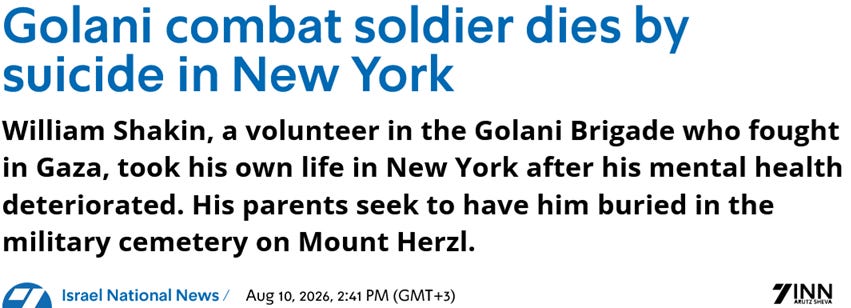 |
Shakin immigrated to Israel following the October 7 massacre and enlisted in the IDF through the Mahal program for overseas volunteers. He served as a combat soldier in the Golani Brigade’s 13th Battalion in Gaza, where he lost friends fighting alongside him. His mental health subsequently deteriorated severely…
…Shakin later returned to the US. He received close support until his flight to New York, but the assistance provided by the IDF and Defense Ministry ended after he arrived overseas.
Haim Meizlish, a volunteer with the Navigating nonprofit, which supports lone soldiers facing mental health difficulties in New York, said Shakin was not recognized as suffering from PTSD during his service and did not receive the support he needed.
According to Meizlish, the Defense Ministry required Shakin to return to Israel to appear before recognition committees. He said this posed a significant difficulty, as returning to Israel would have separated Shakin from his family support system in the US.
Because this absolutely couldn’t be done remotely or any other way, and making a potentially suicidal former soldier fly overseas to stand before committees to prove he needs support is not an “intelligence failure” or monstrously cruel. Where do I sign up for the IDF?
Following Shakin’s death, his parents are seeking to bring their son to Israel for burial in the military cemetery on Mount Herzl.
Yeah, that’s where they need to be devoting their energy, making sure their Molech sacrifice gets buried with the proper recognition in the Valley of Hinnom.
The request has encountered legal and public opposition from the Defense Ministry, in part because Shakin was never officially recognized as a combat trauma victim.
Tough break. I assume this means no free ride for dying al Kiddush Hashem, either.
At least he didn’t waste his life, but sacrificed it for a good cause. The best cause.
Right?


No comments:
Post a Comment