Wander
 |
There is a fundamental question that I think we need to ask ourselves honestly: do we actually want transformational change, or would we prefer to remain safely ensconced in the good old exile? Normalcy bias is a fascinating human condition. We naturally assume that tomorrow will resemble yesterday and that the structures surrounding us are permanent. Even when the familiar is deeply flawed, we often prefer it to the uncertainty of transformation.
There may be no better example than the Jewish People. At the end of Yom Kippur and the Pesach Seder we proclaim, לשנה הבאה בירושלים — “Next year in Jerusalem.” We pray three times every day for the rebuilding of Jerusalem, the restoration of the Davidic kingdom and the return of the Divine Presence to Zion. We speak about Moshiach, the Messiah, sing about Moshiach and teach our children about Moshiach. Some even declare, “We want Moshiach now!” Yet behind all these declarations lies an uncomfortable question: do we really?
It is easy to desire Geulah, redemption, as an abstract theological concept. It becomes considerably more difficult when redemption begins interfering with our lives, because Geulah, by definition, means change. Institutions created to preserve Jewish life under conditions of exile may have to confront an entirely different reality when the Jewish People return to their Land. Questions that remained theoretical for two thousand years suddenly become practical, and portions of Torah that could safely be relegated to the distant future begin knocking on our door.
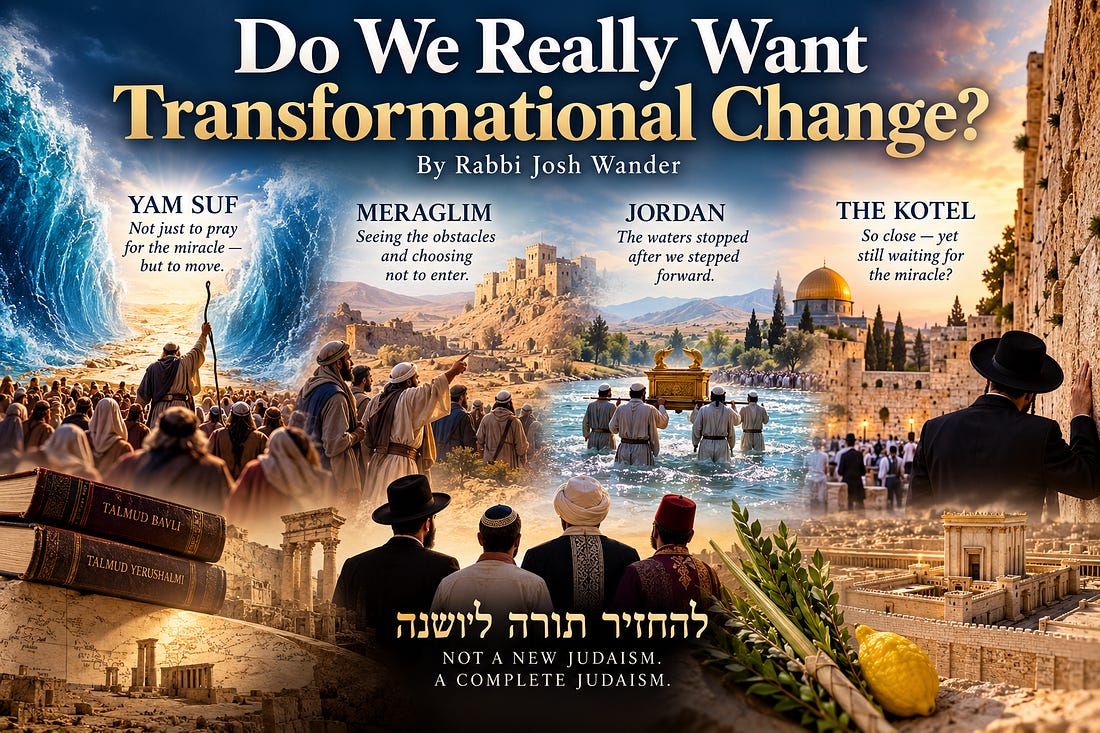
Let me make something absolutely clear. When I speak about transformational change, I am not advocating a reformation of Torah. I am not suggesting that we modernize Torah, dilute Torah, abandon our mesorah, our sacred tradition, or reshape Judaism to accommodate contemporary sensibilities. Quite the opposite. I am suggesting להחזיר תורה ליושנה — “to restore Torah to its former fullness.” We need to rediscover dimensions of Torah life that became dormant or impractical during nearly two thousand years of exile. The transformation I am describing is not a movement away from authentic Judaism, but a movement back toward it.
Over the centuries, we developed an extraordinarily powerful instinct for preservation, and for good reason. We endured persecutions, expulsions, forced conversions, pogroms and relentless attempts at assimilation. The surrounding world constantly demanded that we surrender pieces of our identity, so we learned to resist change. That instinct helped preserve us, but there is a danger that we eventually confused the emergency measures of Jewish survival with the ideal Jewish condition itself.
Perhaps nothing illustrates this more powerfully than Rabban Yochanan ben Zakkai’s famous request as Jerusalem faced destruction: תן לי יבנה וחכמיה — “Give me Yavneh and its sages.” Yavneh represented the genius of Jewish survival. When Jerusalem was being destroyed, Rabban Yochanan ben Zakkai ensured that Torah would survive the catastrophe. But Yavneh was never Yerushalayim. We have taken a בדיעבד — bedi’eved, a necessary response to circumstances that were far from ideal, and risked forgetting the לכתחילה — lechatchila, the ideal situation we were always meant to strive for. Yavneh was what we needed when Jerusalem was lost; it should never cause us to forget what Jewish life is supposed to look like when Jerusalem is restored.
Even our Torah learning reflects the consequences of exile. The Talmud Bavli, the Babylonian Talmud, became overwhelmingly dominant in Jewish learning and halachic discourse, while the Talmud Yerushalmi, the Jerusalem Talmud produced in Eretz Yisrael, the Land of Israel, receded from ordinary study. There were powerful historical and halachic reasons for this, and the Bavli is obviously one of the monumental foundations of Torah Shebe’al Peh, the Oral Torah. But the symbolism is striking: we became extraordinarily proficient in the Torah of Bavel, Babylonia, while becoming comparatively unfamiliar with the Torah of Yerushalayim, Jerusalem. What was historically necessary became normal.
The same phenomenon appears in our relationship with Jerusalem. We leave an unfinished square in our homes as a זכר לחורבן — zecher leChurban, “a remembrance of the Destruction,” place ashes upon the head of a groom beneath the chuppah, the wedding canopy, and break a glass at a Jewish wedding. Yet human beings can normalize almost anything. We eventually stop noticing the unfinished square, and seconds after the glass shatters everyone shouts “Mazel Tov!”, the music begins, and we dance. The broken glass was never supposed to make us comfortable with a broken Jerusalem, and the unfinished wall was never supposed to make incompleteness feel complete. Perhaps we have become better at remembering the Churban, the Destruction, than imagining the Geulah.
When we cannot imagine how the transformation could actually happen, we reach for a convenient solution: Eliyahu HaNavi, Elijah the Prophet, and Moshiach will take care of it. Somehow Eliyahu will arrive, Moshiach will appear, all unresolved questions will be answered, every institution will fall into place, and Jewish history will instantaneously move from one reality to another. This allows us to pray for an entirely different Jewish reality while assuming virtually no responsibility for preparing ourselves to live in it.
But is that really how Jewish history works? Long before the Jewish People crossed the Jordan, they first had to cross the Yam Suf, the Sea of Reeds. They stood at the water’s edge while the mighty Egyptian army—the terrifying embodiment of the Galut, the exile, they had supposedly just escaped—came charging toward them from behind. They had witnessed the Ten Plagues and experienced Yetziat Mitzrayim, the Exodus from Egypt, yet now they stood trapped between Egypt and the sea, waiting.
The Torah’s response is extraordinary. Moshe cried out to Hashem, and Hashem answered: מַה תִּצְעַק אֵלָי דַּבֵּר אֶל בְּנֵי יִשְׂרָאֵל וְיִסָּעוּ — “Why do you cry out to Me? Speak to the Children of Israel and let them journey forward!” There is a time for tefillah, prayer, and there is a time when the answer to our prayer is ויסעו — “Let them move forward.” Chazal, our Sages of blessed memory, describe Nachshon ben Aminadav entering the water and thereby capture the idea beautifully. It was not enough to believe that Hashem could split the sea or to pray that He would do so. Someone had to move toward the obstacle. The miracle was Divine, but the movement had to become human.
Standing still was not neutrality. Egypt was racing toward them from behind while redemption lay ahead through an apparently impossible sea. They could move into the terrifying uncertainty of Geulah or remain frozen before it. That same pattern appeared again when the generation of the Exodus approached Eretz Yisrael. The Meraglim, the spies sent to scout the Land, saw fortified cities, powerful inhabitants and enormous obstacles, and the nation recoiled. Yehoshua and Calev urged them forward, but the generation that had physically left Egypt was not psychologically prepared to enter the Land.
Forty years later, when their children stood at the Jordan under Yehoshua, water again separated the Jewish People from their destination. The Kohanim, the priests, carrying the Aron, the Ark, advanced until their feet entered the Jordan, and only then did the waters stop. At the Yam Suf and at the Jordan, the miracle came from Hashem, but human beings still had to move toward it. The pattern repeats itself: when we stand on the precipice of Geulah, we pause, pray and wait for the miracle that will carry us across, while perhaps Hashem is waiting for us to move. Sometimes the command comes while the sea is still directly in front of us: דבר אל בני ישראל ויסעו — “Speak to the Children of Israel and let them journey forward.”
There may be no more powerful physical illustration of this paradox today than the Western Wall itself. It is much easier to stand at the Kotel, the Western Wall, and pray, as Jews have done for centuries, than to contemplate the monumental leap—albeit geographically only a few feet—to the other side. We can stand before the Wall yearning for redemption and pleading for the restoration of what once stood beyond it, while psychologically remaining perfectly comfortable where we are. It is almost as though thousands of Jews are waiting for a miracle in which they will somehow be picked up and magically deposited on the other side, without having to confront the enormous religious questions and responsibilities that such a transition represents.
Perhaps there is something evocative here in the Torah’s language concerning the Korban Pesach, the Passover offering, and the person who is בדרך רחוקה — “on a distant road.” Chazal debate what constitutes that distance, and one approach allows a person to be physically very close and nevertheless remain outside the relevant boundary. The symbolism is striking. Sometimes the greatest distance is not measured in kilometers. Sometimes it is the few feet separating where we have become comfortable standing from where we have spent generations praying to arrive.
That may describe our predicament remarkably well. We can touch the stones of Yerushalayim, walk its streets and stand before the retaining wall of Har HaBayit, the Temple Mount, yet physical proximity does not necessarily eliminate psychological or spiritual distance. From the Yam Suf to the border of Eretz Yisrael, from the Jordan to Yerushalayim, and perhaps even from the Kotel to the other side of the Wall, the question keeps returning: are we waiting for Hashem to perform a miracle so that we will finally move, when perhaps Hashem is waiting for us to move so that the miracle can unfold?
Geulah may also require thousands of smaller changes that force us to distinguish between eternal Torah and the cultural circumstances through which Torah traveled during Galut. It could be something as mundane as clothing. A Jew whose ancestors dressed for the freezing winters of Poland or Russia might ask whether every element of that clothing must remain unchanged under the blazing sun of Eretz Yisrael. A Chassidic Jew might become physically more comfortable in different clothing while becoming philosophically very uncomfortable with the change.
That discomfort is instructive because clothing communicates identity and connects us to our fathers and grandfathers. There is something beautiful about that continuity. But we must still be capable of asking which parts of our identity are Torah and which are the historical clothing in which Torah traveled through exile. This is not a call to discard minhagim, customs, or reinvent Judaism. If something is Torah, we preserve it because it is Torah. If it is a sacred minhag, we treat it with reverence. But we should also be capable of recognizing what developed in response to particular historical circumstances.
Nor should we judge another Jew’s holiness by appearances. Perhaps the simple Jew wearing an almost transparent kippah possesses greater yirat Shamayim, fear and awe of Heaven, emunah, faith, and sincerity than someone dressed in a long black coat with a beard and payot, sidelocks, or perhaps the reverse is true. We cannot know. Clothing is visible, but the neshamah, the soul, is not.
The Arba Minim — ארבעת המינים, “the Four Species,” teach this beautifully. Chazal saw the four species as representing different kinds of Jews. Some possess Torah and good deeds, some possess one but not the other, and some appear to possess neither. Yet we do not discard the seemingly inferior species; we bind them together. The aravah, the willow, has neither the taste nor fragrance attributed to the other species, yet without it we cannot fulfill the mitzvah, the commandment. We cannot construct Geulah by deciding that holiness belongs exclusively to those who resemble us.
None of this means erasing communities or producing a homogeneous new Israeli Jew. A Chassid should remain a Chassid, a Sephardi should preserve his mesorah, a Yemenite should treasure his traditions and an Ashkenazi should preserve his. The objective is not uniformity. It is recognizing the difference between preserving our mesorah and fossilizing Galut.
This is why להחזיר תורה ליושנה — “to restore Torah to its former fullness” is so important. I am not speaking about reforming Judaism; I am speaking about restoration. I am not suggesting that we remove things from Torah because they make modern people uncomfortable. I am asking whether we are prepared to restore parts of Torah that make us uncomfortable precisely because we have not lived them for two thousand years. Geulah does not mean replacing Judaism with something new. It means allowing Judaism to become whole again.
Our ancestors built an extraordinary Judaism capable of surviving without sovereignty, without Jerusalem, without the Beit HaMikdash, the Holy Temple, and, for most Jews, without Eretz Yisrael itself. That achievement preserved us through extraordinary circumstances, and we should approach it with enormous gratitude and humility. But survival was never the final destination. The Nevi’im, the Prophets, repeatedly describe the ingathering of the Jewish People, the rebuilding of the Land and the restoration of Jerusalem. Our tradition itself demands transformation.
Galut can become remarkably comfortable. We can build magnificent shuls and yeshivot, synagogues and Torah academies, kosher supermarkets, schools, mikvaot, ritual baths, and entire neighborhoods in which one can live a completely Jewish life. After enough generations, however, the temporary begins to feel permanent, and we risk confusing the preservation of Judaism during exile with the preservation of exile Judaism itself. Our ancestors carried the flame through the darkness, but surely the purpose of carrying a flame through a tunnel is eventually to emerge from the tunnel, not to become so attached to the tunnel that daylight itself begins to seem threatening.
Our challenge, therefore, is not to choose between tradition and transformation. That is a false choice. Our challenge is to distinguish between what is eternal and what was an adaptation to exile. Torah is eternal, but Galut is not. Our mesorah is sacred, but our historical circumstances are not. Yavneh saved us when we lost Yerushalayim, but the success of Yavneh was never supposed to make us forget Yerushalayim.
Torah speaks about much more than the synagogue, study hall, home and community. It speaks about agriculture, government, armies, courts, national life, pilgrimage, korbanot, offerings, the Beit HaMikdash and the relationship between a sovereign Jewish nation and the nations of the world. For generations, much of that reality existed primarily in our books. Now we have returned to Eretz Yisrael. Hebrew is once again spoken by millions of Jews. Jewish sovereignty has returned. Jewish soldiers defend Jewish cities, and Jerusalem is once again filled with Jews. Whatever one believes about precisely where we stand in the redemptive process, Jewish history is clearly no longer standing still. The question is whether we are.
We have become remarkably comfortable praying for things whose actual arrival might profoundly disrupt us. We ask Hashem to gather the exiles, but what happens when that means leaving the countries in which we have built comfortable lives? We pray for Jerusalem, but what happens when Jerusalem requires something from us? We pray for the restoration of Jewish national life, but what happens when that requires rebuilding institutions dormant for centuries? We pray for Moshiach, but what happens when redemption stops being a song and becomes a responsibility? Perhaps we do not fear Geulah itself as much as we fear what Geulah might require us to change.
Perhaps this is one of the great spiritual challenges of our generation. We inherited Yavneh, but we have returned to Yerushalayim. We inherited a Torah preserved with extraordinary courage throughout the four corners of the earth, but we have brought that Torah home. Now we have to ask what that means, not by abandoning what our ancestors preserved, but by completing what they began; not by reforming Torah, but by להחזיר תורה ליושנה — restoring Torah to its former fullness; and not by rejecting the Judaism that carried us through Galut, but by asking what that Judaism was carrying us toward.
We have spent nearly two thousand years saying לשנה הבאה בירושלים — “Next year in Jerusalem,” and the question is no longer merely whether we remember Jerusalem, but whether we are prepared for Jerusalem to become real. We have spent nearly two thousand years praying for transformational change, mourning what we lost and dreaming about what will return. Perhaps the lesson of the Yam Suf is that there eventually comes a moment when another prayer is not enough, when standing still is itself a decision, and when the response from Heaven is מַה תִּצְעַק אֵלָי… דַּבֵּר אֶל בְּנֵי יִשְׂרָאֵל וְיִסָּעוּ — “Why do you cry out to Me? Speak to the Children of Israel and let them journey forward.” After all those prayers, all those tears and all those generations, perhaps the most fundamental question we can ask ourselves remains the simplest: Do we actually want it?
https://geulamovement.substack.com/p/do-we-really-want-transformational?


No comments:
Post a Comment