Overcoming Lethal Shekalim Before Haman Gets Started - The Chida Revolutionizes Purim
The View of the Michtav M'Eliyahu of the Return to Eretz Yisroel After the Holocaust
Purim: Infusing the Simcha of Adar into the Whole Year
Terumah: Tachash Skins in the Tabernacle
The uppermost covering of the Mishkan, the mobile Tabernacle of the desert, was made from the colorful skins of the Tachash. The exact nature of this unusual animal is not clear. The Sages (Shabbat 28b) were not even sure whether the Tachash was a kosher animal. According to Rabbi Meir, it was a unique, multi-colored creature, with a single horn in its forehead. After the Tachash made its appearance in the time of Moses, it disappeared from sight.
How could the holy Tabernacle be constructed from an impure animal? What purpose would this serve?

The difference between pure and impure is similar to the difference between good and evil. These distinctions are true and valid, and it is necessary for our moral development to recognize and emulate good, while abhorring evil and corruption. However, these distinctions are really only by way of comparison.
Good and evil are in fact relative terms. On a very fundamental level we recognize — at least intellectually — that everything has some ultimate purpose and value. Nothing can exist, nothing was created, which is absolute evil. Everything must relate, on some level, to the underlying good of the universe.
This abstract recognition of the hidden value of evil has no practical application, since morality is based upon the strongest possible feelings of hatred for evil and love for good. Therefore, when it comes to fulfilling mitzvot, which are practical ethical guidelines, it is not appropriate to use impure objects.
The Tabernacle, however, may have been an exception to this rule.
The generation of Jews who lived in the desert for forty years was a special generation. Their spiritual achievements were for all times. They encompassed the essence of all future generations, so that the covenant they made with G–D — and the Torah which they accepted upon themselves — obligated not only their generation, but all future ones as well.
Like the special generation of the desert, the Mishkan embodied timeless aspects of the universe. The holy sanctuary of the desert was not a matter of specific morality for a particular era, but encompassed the expanse of all times and all things. It reflected the beautiful harmony of the entire universal order, and the divine aim of elevating all of creation. It was therefore possible that its outermost covering was made from an impure animal.
The Tachash, with its many hues and colors, represented the ultimate value of the many forces in the world, in all their variations. Its inclusion in the Tabernacle, albeit in its outermost layer, enabled an expression of our intellectual recognition of G–D’s essential unity, that nothing exists outside of Him, and that all was created in His Glory.
(Gold from the Land of Israel, pp. 147-148. Adapted from Ein Eyah vol. III, pp. 105-107)
First in Genesis was “Heaven and Earth”, and this was symbolized by the Two Tablets in the Ark of the Covenant contained within the Mishkan’s “Holy of Holies”. Of the Ten Commandments, the first half deal with mitzvot between man and God, while the second half are between man and fellow. (The fifth, honouring parents, is thought to be a bit of both.) So, we can see how one Tablet would correspond to “Heaven” and the other Tablet to “Earth”!
Next on the list is the Rakia, often poorly translated as “Firmament”. This was created on the Second Day to separate “between the waters” above and below, ie. between the Heavens and the Earth. The Midrash states that in the Mishkan it corresponded to the parokhet, the curtain that separated the Holy of Holies from the rest of the Tabernacle. Interestingly, in describing the “Seven Heavens”, the Talmud (Chagigah 12b) teaches that the first and lowest of the Heavens—right beneath the Rakia—is called Vilon, literally meaning “curtain” in Latin (velum).
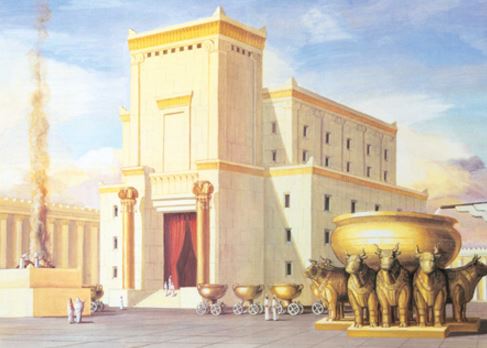
Illustration of the First Jerusalem Temple, with “Molten Sea” on the right.
On the Third Day, God “gathered the waters” to form the oceans, and this paralleled the Mishkan’s kior, the copper laver where the kohanim washed. Later, King Solomon built a much larger “Molten Sea” in front of Jerusalem’s Temple, supported by a dozen statues of oxen (the connection between this Molten Sea and mathematical pi was discussed previously here). Also on the Third Day, God formed the lands and made them flourish with grasses and plants. Similarly, the Mishkan had the Shulchan with ever-fresh loaves of bread.
On Day Four, God created the luminaries, of which there are seven visible to the naked eye: sun, moon, Mercury, Venus, Mars, Jupiter, and Saturn. The Seven Luminaries play a big role in ancient texts, both Jewish and non-Jewish. In fact, in many cultures and languages, the seven days of the week are named after them. In English: Saturday, Sunday and Monday are named after Saturn, sun, and moon. Tuesday, Wednesday, Thursday, and Friday are named after the Norse gods Tiw, Woden (or Odin), Thor, and Frigg (or Frei), corresponding to Mars, Mercury, Jupiter, and Venus. The connection is easier to see in the French names for these days: mardi, mercredi, jeudi, and vendredi. The Midrash explains that in the Mishkan, the Seven Luminaries were represented by, of course, the luminous Menorah with its seven branches.
On the Fifth Day, God created winged animals, and corresponding to these are the Kruvim, the winged Cherubs on the Ark of the Covenant. The Midrash doesn’t say anything about fish, which were also created on the Fifth Day. Intriguingly, the Mishkan (and later Temple) had a variety of offerings including fruits, grains, and breads, birds and land animals—but no fish! However, the special blue tekhelet dye that was used in the Mishkan fabrics and priestly garments does come from sea snails, so perhaps we can add that to the list in the Midrash.
The main creation of Day Six was Adam. The Midrash says that God brought Adam into the Garden of Eden on that same day, leading the first human into that special holy place. Similarly, in the Mishkan we had Aharon serve as kohen gadol, representing Adam, and entering the Holy of Holies, the Mishkan’s special “Garden of Eden”. The Midrash adds that Aharon was greater than Adam, since Adam sinned in the Garden, but Aharon atoned for sin in the Holy of Holies. This further helps us understand the true role of the kohen: to restore some of the world’s lost holy light.
After Adam consumed of the Forbidden Fruit, God called out ayekah (איכה), “where are you?” (Genesis 3:9) As explored in the past, this word can be broken down into ayeh koh (איה כ״ה), “where is the 25?” The 25 alludes to the 25th word of the Torah which is ohr, “light”. So, God was really asking “Where is the light of Creation?” for Adam and Eve caused that light to be lost. All of Israel is called to be a light unto the nations, and restore that light to the world. Within Israel, the kohanim in particular had to take the lead. And they would bless the people of Israel to help them accomplish this task, as the Torah states: koh tevarkhu et bnei Israel (Numbers 6:23). In fact, the kohen himself is a koh-en, a bringer of that hidden light. The Midrash actually goes on to say that, really, all of Israel are likened to kohanim, and will all become kohanim in the future, as it is written, “You shall all be called ‘priests of God’ [kohanei Hashem], and ‘servants of God’ shall be said of you; you shall enjoy the wealth of nations and revel in their honour.” (Isaiah 61:6)
And Hashem promises many more rewards: in the merit of the parokhet that the Israelites made corresponding to the Rakia, God promises to make us all glow like the Heavens, as it says, “And the wise ones shall glow like the glow [zohar] of the Rakia…” (Daniel 12:3) In the merit of the Shulchan, God promises to bless the land and its fruits (Leviticus 26:4). In the merit of the Menorah, God promises to bring upon us the light of the Shekhinah, and magnify the light of the luminaries, as it says in Isaiah 30:26 that “the light of the moon shall become like the light of the sun, and the light of the sun shall become sevenfold…” Finally, in the merit of the Cherubs that correspond to the flying creatures, God will end the exile and fly us all back to Israel “like doves to their cotes” (Isaiah 60:8). This would have been very hard to imagine for most of history, until recent decades, as we can now literally fly to the Holy Land!
Thankfully, we have already seen these promises begin to be fulfilled right before our eyes. We are nearing the finish line, and we will soon see the return of Hashem’s Sanctuary, together with all of its holy vessels and the Ark of the Covenant, in an everlasting edifice, at its rightful place in the Holy Land.
https://www.mayimachronim.com/the-mishkan-the-cosmos/
that’s the right idea!
Rabbi Avraham Gurwicz, head of the Beis Yosef Yeshiva in Gateshead, England, and one of the senior Roshei Yeshiva in Europe, recently sent a letter to the Jewish residents of London in light of the looming education decree in the country. The government is demanding the inclusion of secular studies and other subjects that contradict the Torah in the curriculum of boys’ and girls’ educational institutions of all ages.[…]
Go here to read the article https://vinnews.com/2025/02/26/rabbi-avrohom-gurwicz-if-secular-studies-law-passes-in-britain-jews-must-leave-country/
WHERE IS THE SIMCHA?
““Mishenichnas Adar Marbim b’simcha …. With the coming of Adar, simcha increases.”
We have arrived at that moment, but where is the simcha?
It seems to me that there is an overwhelming sense of apprehension, distress and fear, as if the world is about to explode.
For example: much of the Jewish World was ecstatic when Donald Trump was elected. He saw clearly the evil of the barbarians with whom Israel had been fighting, and it seemed as if all would be well. But then something incomprehensible occurred. After eighteen months of fighting, during which we were told that our enemies had been defeated, Israel made a deal to free the hostages. I understand why it was necessary to make it, but it is a horrible deal.
Apparently, our enemies have not been defeated.
Chazal say that, if we fail to do teshuva in the Days Before Moshiach, then “the Holy One Blessed is He, will appoint a ruler over [us] whose decrees will be as harsh as [those of] Haman,” and we will be frightened into doing teshuva. (Sanhedrin 97b)
My friends, I want to say that now, in the Month of Adar, the lessons of Purim are looming larger than ever. How does the Megillah begin?
“Achashveros … reigned from Hodu to Cush, over one hundred twenty-seven provinces ….” which our commentators understand to mean “the entire world.”
The Jews were surrounded! There was no place to go and no place was safe. The entire world was a seething cauldron of hatred, and all it would take was one spark to ignite the explosion.
Oh yes, we were comfortable in Shushan ha Bira. Too comfortable! There was a “week-long feast for all the people, great and small alike.” Just like today, when we are so comfortable in the lavish feast all around us, eating and drinking in the world of strangers.
In the Shema, it says that “you will eat and be satisfied.” At that exact point, where we feel satisfied, the Torah warns us, “beware lest your heart be seduced.” When our stomachs are full, our senses are dulled and we are prone to “turn astray and serve gods of others.” Yes, the banquet even has kosher food, but it is not our banquet. As the Torah warns us, “Yeshurun became fat and kicked.” (Dvarim 32:15)
It is crucial to focus on what Queen Esther identifies as the way to save her people. “Go, assemble all the Jews … and fast for me … and then I will go to the king ….”
We are at this moment feasting at the banquet of the Other Nations. We have forgotten who we are. This is not our banquet! Listen to the words of Esther ha Malka: “assemble ourselves … fast,” and then go to the King.
What is Queen Esther telling us?
First, we have to “assemble.” We Yidden are splintered into countless factions. Unless we stop fighting and become “like one man with one heart,” we are not going to make it. There is absolutely no hope unless we become one family.
I know it seems impossible, but survival is a potent argument. The fact is that we have no choice. Without achdus we cannot be saved.
Second, we have to “fast.” We have to leave the banquet of the surrounding nations, even if their food is glatt kosher. We have to eat from our own table, not their table.
If we do these two things -- become one and leave the foreign banquet -- then we will be able to “enter the presence of the King of Kings.”
My friends, I know it sounds impossible. We think that we cannot do it. We cannot become one and we cannot leave their banquet! It is hopelessly unrealistic, right?
It was also “unrealistic” that we would ever get out of Mitzraim, but when survival is at stake, somehow the impossible becomes possible.
That is why our sages tell us, if we do not do teshuva in the days before Moshiach, a king as cruel as Haman will appear, and then there will be no choice. Fear and trembling are very good teachers. The Jews felt secure in Germany until suddenly Hitler – y’mach shemo – appeared out of “nowhere.”
The reality is that Hashem will not let us disappear. Since He loves us, He will bring about the means of our salvation.
“Go, assemble all the Jews … and fast for me.”
When we do this, then we will merit to appear before the King of Kings, and it will be said about us, “The Jews had light and gladness, joy and honor.” (Megillah 8:16)
May we see it soon in our days!

 |
| The Banquet |
Adar: the Jewish month in which Purim is celebrated
Chazal: the rabbis of the Mishna and Gemora
Mitzraim: Ancient Egypt
Shushan ha Bira: capital city of King Achashverosh
Simcha: joy
Teshuva: repentance
Y’mach shemo: may his name be ground to dust
Thirtysix.org Online Bookstore Link: https://thirtysix.org/shop/. To order directly from Amazon just search for books by Pinchas Winston.
WE’RE IN PURIM territory now. Shabbos is the first of Adar and Parashas Shekalim. On a Pshat level that may not mean very much, but on a Sod level there is so much going on.
For example, the verse says:
And they shall make Me a sanctuary and I will dwell in their midst… (Shemos 25:8)
The verse is talking about building a Mishkan for the Divine Presence where the kohanim can perform the daily service. But according to the Midrash, the physical Mishkan was only in response to the incident of the golden calf, so they explain the verse to be talking about every individual Jew. It is telling us that every Jew should make themself into a Mishkan that G-D can dwell within. As the Nefesh HaChaim explains, our brains correspond to the Holy of Holies, and our hearts to the altar.
In simple terms, this means being righteous, giving yourself over to the service of G-D. It means spiritually cleaning house because G-D will not dwell anywhere that is not holy. Perhaps prior to the golden calf this was something that every Jew could do, at least on their own level. But certainly post-calf so few people seem capable of achieving such high levels of spiritual greatness, making them incapable of being a dwelling place for the Shechinah.
Yes and no, especially according to the opinion that the Mishkan was commanded after the golden calf, and the change back to mortality of the Jewish people. If so, then the Mishkan becomes a spiritual road map to becoming someone G-D can dwell within. And Purim, just two weeks away b”H, is one of the best ways to see how successful you have been to date.
We have a mitzvah to be happy. We certainly have a mitzvah to serve G-D with joy. But how hard is that to do when you have nothing to make you sad? How difficult is that when G-D seems to make things go the way you want them to?
On the other hand, can G-D expect a person to be happy when they are mourning a loss, especially a very difficult one? Does He expect a person to not hold a grudge against Him when everyone around them seems to be succeeding, and they can’t, time after time? Some people seem to have consistently good mazel while others seem to have just the opposite, and no one can explain why.
The Midrash Rabbah, on last week’s parsha on the words, “And these are the judgments, etc.” says, that Iyov stopped questioning G-D about what was happening to him when he considered what had happened to great people before him, like Avraham, Yitzchak, and Ya’akov. Then he realized that he really couldn’t understand G-D’s judgment, so he really couldn’t question it.
For example, I found out last week about a nine year old girl who didn’t wake up, the niece of someone I know. That is two years after the eleven year old granddaughter of a friend of mine also died similarly. And that’s against a background of dead hostages being returned, including children, who were brutally murdered. Who understands any of that?
It depends on which level you are asking the question. The world outside the Mishkan is where the reality of G-D is the least felt and, people believe the most in nature as a force. In that world, the questions abound about why things happen to good people to the point that people feel compelled to assume that G-D is not involved in human history.
When you entered the first area of the Mishkan, the Courtyard, the reality of G-D was more real. The focus was on G-D and how to serve Him. Miracles already occurred there just because of the level of consciousness present there. The questions became fewer if only because it was clear that G-D was in the world and fully in charge.
Beyond the Courtyard was the Sanctuary where only kohanim could go. It was home to the Menorah, the Shulchan and Showbread, and the Incense Altar. It was part of this world, and yet separate from it. The only way to describe the atmosphere was Messianic because the good was so overpowering. If a person had questions of emunah going in there, they didn’t have them coming out.
Finally, there was the Holy of Holies, the place of the Holy Ark. It was ten amos by ten amos, but time and space didn’t matter there. It was so holy that only the Kohen Gadol could go in and, that was only once a year on Yom Kippur. The Laws of Physics ceased to operate there, which is why the Aron HaKodesh could be too big for the space and yet still fit.
The progression from one area to another represented a person’s spiritually progression as well, from their heart, their personal altar, to their mind, their personal Holy of Holies. Being human mishkans, we possess the potential to do the same in ourselves, and to be happy despite the things in life trying to make us miserable. We drink on Purim, not to drown our sorrows, but to discover how to be happy despite them.
How? The answer to that question is the reason for my latest book, “Taking It Even Higher: Going Beyond Everyday Reality.” And to help with this answer, I am giving a two session webinar, b”H, on March 4 and 11 on this topic. To register go to https://www.shaarnunproductions.org/webinars.html.Shaarnun Productions. For more details, write to pinchasw@shaarnun.org. And while you’re there, you can also check out my new Haggadah, b”H, called “The Wise Son Says.”
Good Shabbos
Pinchas Winston
The parsha of Terumah follows those of Mishpatim and Yitro. In parshat Yitro we experienced the moment of the revelation at Mount Sinai and the granting of the Torah to the Jewish people. In parshat Mishpatim the Torah began to fill in the details of Jewish law and life, especially as they relate to human and societal behavior and the standards of such behavior that the Torah wishes us to uphold.
In this week’s parsha of Terumah, the Torah presents another challenge to human behavior – wealth, money, charity and the ability to give away what one may deem to be his or hers. The Torah demands from us the ability to donate to others, to give to great causes, to the public welfare and to be able to share with others our material possessions.
The rabbis of the Talmud stated that this is one of the major identity tests of life. Miserliness, a bad eye and an unwillingness to be able to contribute to others in need are held to be violations of Torah principles and morals. The Torah at Sinai instructed us not to steal, not to take from others what belongs to them without their explicit consent. Now the Torah raises the bar and asks us to be able to give away what we deem to be ours to others less fortunate than us or to national and religious causes that benefit us all.
All of this is implied in the request for donations to help build the holy Mishkan/Tabernacle. The Lord could have provided us with a ready built spanking new Mishkan/Tabernacle on His own. Instead He challenged us then and in every continuing generation of Jewish life to build a Mishkan/Tabernacle on our own and from our own resources. And that requires a proper view of our own wealth and what we do with it.
My beloved Talmud rebbe taught me over seventy years ago how to read the daily newspaper – how to filter out the golden nuggets of life and morality from the overwhelming amount of dross that fills the pages of our newspapers. There was an item in the newspaper about a baseball pitcher who gave up a guaranteed salary of twelve million dollars for 2011 and retired from the game because he felt in all honesty that he could no longer pitch effectively and did not wish to be paid for essentially doing nothing. This naturally goes against the grain of the vast majority of professional athletes whose greed and avarice is so well known. That is why it made news – it was a man bites dog story. But it indicated to me that the lesson of parshat Terumah still lives in the human heart.
To be able to walk away from money not honestly earned is a Torah value. And to share and give of our wealth to others and to the building of society, to Torah education and a national home for Jews, is also a supreme Torah value. We have to build our own Mishkan/Tabernacle constantly in every generation. The Torah’s attitude towards the sharing of our wealth is the key to such a form of Mishkan/Tabernacle building.
Shabat shalom, Rabbi Berel Wein
bs’d
Fine Afternoon With the Flock
After the cold, a little sunshine
Scenic Shomron.
The Hills of Efrayim.

It’s less than a minute.


Happy winter/spring,
Dean Maughvet
Same to you Dean!
The Civil Administration today (Tuesday) carried out extensive enforcement actions against illegal construction in Judea and Samaria, demolishing illegal structures in two main locations – near Migdalim and in Ma’arava in Samaria.

The Enforcement Unit demolished illegal structures near the village of Majdal Bani Fadil, in an attempt to stop Palestinian construction and prevent takeover of land near Migdalim.
At the same time, a large building and a number of small structures were demolished in Gush Ma'arava, near Highway 5. This area is a central site in the struggle against illegal construction as part of the "Fiyyad Plan," which Israeli sources claim is aimed at promoting Palestinian takeover of Area C.
Minister Bezalel Smotrich, who is in charge of the Civil Administration, welcomed the action and emphasized: "Our policy is clear – we will take action using all means to stop this illegal Palestinian construction and takeover. Such demolitions are a necessary step to protect our national interests and the future of Jewish residence in Judea and Samaria."
Minister Smotrich added: "The struggle for the future of Area C is at a decisive point. Our message is clear and unequivocal – we will not enable a Palestinian takeover of the area and we will completely cut down any idea of a Palestinian state."
https://www.israelnationalnews.com/news/404509
HOWEVER:
……How close is our War against the Vermin Terrorists
IDF deploys tanks in West Bank for first time since 2002,
sending 3 to Jenin as it expands op
Defense minister says he instructed army to stay ‘for coming year’ in West Bank refugee camps and not allow 40,000 displaced Palestinians home
More at https://www.timesofisrael.com/idf-deploys-3-tanks-to-jenin-for-1st-time-since-2002-as-it-expands-west-bank-op/
[ Not only France, but “Flames of Wrath: 8 Shocking Sights From France, Italy & Albania As Explosive Unrest Grips Europe". This is...

