Another perspective [wonder if they kept the Shabbos?]
* * * * *
The recent historic proclamation builds on a great American tradition of respecting and celebrating Shabbat as a source of spiritual uplift.
President Trump’s remarkable proclamation on May 4th in honor of Jewish Heritage Month is the first time an American president has publicly encouraged Jews to observe Shabbat.
“In special honor of 250 glorious years of American independence and on the weekend of Rededicate 250 — a national jubilee of prayer, praise, and thanksgiving — Jewish Americans are encouraged to observe a national Sabbath,” the President stated.
Even more remarkably, he suggested that all Americans be inspired by the Jewish day of rest. “From sundown on May 15 to nightfall on May 16, friends, families, and communities of all backgrounds,” the proclamation continues, “may come together in gratitude for our great Nation. This day will recognize the sacred Jewish tradition of setting aside time for rest, reflection, and gratitude to the Almighty.”
[he didn’t say to “keep” Shabbos like the Jews, but “rest, reflection, and gratitude to the Almighty”. It means Christians and Jews in their own way”]
While this presidential-level public encouragement of Shabbat observance is a first, Jews have been observing the seventh day’s holiness since the birth of the American Republic, and that fealty to our faith has helped encourage all Americans to live up to our nation’s founding ideals.
The First Religious Freedom Case in American History
Jonas Phillips (1736—1803), a proud patriot, Revolutionary War veteran, and merchant based in New York and Philadelphia, was summoned to court in April of 1793. The court records note that: “In this cause (which was tried on Saturday, the 5th of April), the defendant offered Jonas Phillips, a Jew, as a witness; but he refused to be sworn, because it was his Sabbath. The court, therefore, fined him 10 pounds; but the defendant, afterwards, waiving the benefit of his testimony, he was discharged from the fine.”
Director of the Stanford Constitutional Law Center Judge Michael McConnell has called this case, Stansbury vs. Marks, the “first recorded case raising free exercise issues following the adoption of the first amendment.” The proudly Jewish Phillips, in his refusal to violate the Shabbat, demonstrated in America’s earliest years how the country stands in respect of religious diversity and freedom.
In another essay he reflected how keeping the Sabbath as an example of how God is worshipped “not with the shouts of fanaticism, nor the fretful penances of temporal authority - not as dealing damnation to one sect and blessings to others - not as crushing one portion of [H]is creation and elevating another: but as a just and righteous God.”
A Father's Letter to Lincoln
Later, during the Civil War, Bernhard Behrend, of Narrowsburg, Sullivan County N.Y. wrote to President Lincoln requesting that his son, fighting for the Union, be allowed to observe the Jewish day of rest. Behrend’s letter, dated December 4, 1862, begins by noting that “By your order of the 16th day of November, 1862, you recommend that the officers and men of the army shall observe the Sabbath and do no work on Sunday, because we are a Christian people.” “But,” Behrend continued, “according to the Declaration of Independence and according to the constitution of the United States, the people of the United States is not a Christian people, but a free, sovereign people with equal rights, and each and every citizen of the United States has the right and liberty to live according to his own consciousness in religious matters, and no one religious denomination, be it a majority or minority of the people, can have a privilege before the other under this our beloved constitution.”
As such, the father argued on behalf of his child as follows:
“I gave my consent to my son, who was yet a minor, that he should enlist in the United States army; I thought it was his duty, and I gave him my advice to fulfill his duty as a good citizen, and he has done so. At the same time I taught him also to observe the Sabbath on Saturday, when it would not hinder him from fulfilling his duty in the army. Now I do not want that he shall be dragged either to the stake or the church to observe the Sunday as a Sabbath. Your Excellency will observe in this my writing that I am not very well versed in the English language, and if there should be found a word which is not right, pardon it, and never such a word shall be construed so as if I would offend your Excellency or the people; for I love my country, the Constitution, and the Union, and I try to be always a loyal citizen.”
While there is no record of Lincoln ever responding to Bernhard Behrend’s letter, he did later issue a general order permitting Jewish soldiers to be furloughed during their Holy Days.
Of course, countless Jewish Americans struggled to provide for their families and lost jobs that demanded they work on the day of rest. But following the rise of the modern civil rights movement, most conventional American workplaces understand and respect its observance.
Title VII of the Civil Rights Act of 1964 requires employers to “make reasonable accommodations for an applicant or employee whose sincerely held religious belief, practice, or observance conflicts with a work requirement, unless providing the accommodation would create an undue hardship for the employer.”
The Senator Who Kept Shabbat
The 20th century’s most famous Shabbat-observing political figure was Joseph Lieberman. Early in his career, as a Connecticut state senator, a budget stalemate was broken late Friday in 1971. At the direction of Majority Leader Ed Caldwell, the chamber delayed the vote, observed the day of rest, and passed the budget on Saturday night. The next day’s local paper carried the headline: “Butch Caldwell and the Sundown Kid.” Lieberman, who served a distinguished career in the Senate, would later come within 537 votes of the vice presidency in the presidential 2000 election.
In 2011, Lieberman authored The Gift of Rest: Rediscovering the Beauty of the Sabbath, noting its crucial importance in our digitally-infused age. “Every generation has its own pharaoh and its own slave masters uniquely based on the culture of the time,” he wrote. “Our pharaoh may be the electronic devices—computers, televisions, iPhones—that mesmerize us, dominating hour after hour of our lives…Too often they show us an electronic alternative reality full of negativity, trivia, or degradation. From all this, the Sabbath offers to free us for a twenty-four-hour period.”
Just a few months ago, I myself was lucky enough to speak at the White House about how Jewish ideas have inspired America. Not only did the organizers of the event accommodate my request to have the panel on which I spoke be at a time that would allow me to observe Shabbat in a local community, as I left the White House in the late afternoon, someone walking in saw my kippah and said “Have a good Shabbos!”
The recent proclamation, then, while undoubtedly historic, builds on a great American tradition of respecting, accommodating and celebrating the seventh day as a source of spiritual uplift.
https://aish.com/trumps-shabbat-proclamation-and-americas-founding-promise/
The Hebrew Bible played a major role in the creation of the United States and its democracy.
The creation of the United States of America represented a watershed moment in world history. Unlike other countries where democracy evolved over a period of hundreds of years, the United States was the first country to be created, from its inception, as a democracy. And the Bible – and Jewish values – played a major role in this process.
Many of the earliest "pilgrims" who settled the "New England" of America in early 17th century were Puritan refugees escaping religious persecutions in Europe.
These Puritans viewed their emigration from England as a virtual re-enactment of the Jewish exodus from Egypt. To them, England was Egypt, the king was Pharaoh, the Atlantic Ocean was the Red Sea, America was the Land of Israel, and the Indians were the ancient Canaanites. They were the new Israelites, entering into a new covenant with God in a new Promised Land.
Thanksgiving – first celebrated in 1621, a year after the Mayflower landed – was initially conceived as a day parallel to the Jewish Day of Atonement, Yom Kippur; it was to be a day of fasting, introspection and prayer.
Writes Gabriel Sivan in The Bible and Civilization (p. 236):
"No Christian community in history identified more with the People of the Book than did the early settlers of the Massachusetts Bay Colony, who believed their own lives to be a literal reenactment of the Biblical drama of the Hebrew nation... these émigré Puritans dramatized their own situation as the righteous remnant of the Church corrupted by the 'Babylonian woe,' and saw themselves as instruments of Divine Providence, a people chosen to build their new commonwealth on the Covenant entered into at Mount Sinai."
During the Puritan Revolution in England, (1642-1648) some Puritan extremists had even sought to replace English common law with Biblical laws of the Old Testament, but were prevented from doing so. In America, however, there was far more freedom to experiment with the use of Biblical law in the legal codes of the colonies and this was exactly what these early colonists set out to do.
The earliest legislation of the colonies of New England was all determined by Scripture. At the first assembly of New Haven in 1639, John Davenport clearly stated the primacy of the Bible as the legal and moral foundation of the colony:
“Scriptures do hold forth a perfect rule for the direction and government of all men in all duties which they are to perform to God and men as well as in the government of families and commonwealth as in matters of the Church... the Word of God shall be the only rule to be attended unto in organizing the affairs of government in this plantation." 1
Subsequently, the New Haven legislators adopted a legal code – the Code of 1655 – which contained some 79 statutes, half of which contained Biblical references, virtually all from the Hebrew Bible. The Plymouth Colony had a similar law code as did the Massachusetts assembly, which, in 1641 adopted the so-called "Capitall Laws of New England" based almost entirely on Mosaic law.
Without the Jewish Oral Tradition that was crucial to understanding the Bible, the Puritans were left to their own devices and tended toward a literal interpretation. This led in some instances to a stricter, more fundamentalist observance than Judaism had ever seen.
Jewish Influence on Education
The Hebrew Bible also played a central role in the founding of various educational institutions including Harvard, Yale, William and Mary, Rutgers, Princeton, Brown, Kings College (later to be known as Columbia), Johns Hopkins, Dartmouth etc. Many of these colleges even adopted some Hebrew word or phrase as part of their official emblem or seal. Beneath the banner containing the Latin "Lux et Veritas", the Yale seal shows an open book with the Hebrew "Urim V'Timum", which was a part of the breastplate of the High Priest in the days of the Temple.
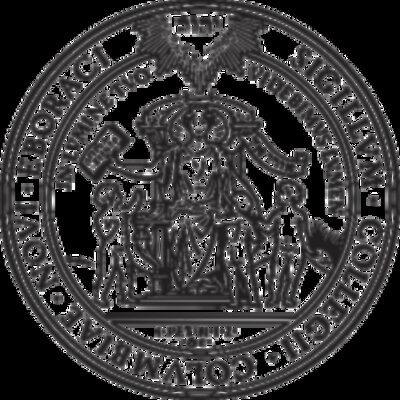 Columbia College seal
The Columbia seal has the Hebrew name for God at the top center, with the Hebrew name for one of the angels on a banner toward the middle. Dartmouth uses the Hebrew words meaning "God Almighty" in a triangle in the upper center of its seal.
So popular was the Hebrew Language in the late 16th and early 17th centuries that several students at Yale delivered their commencement orations in Hebrew. Harvard, Yale, Columbia, Brown, Princeton, Johns Hopkins, and the University of Pennsylvania taught courses in Hebrew – all the more remarkable because no university in England at the time offered it. (In America, Bible study and Hebrew were course requirements in virtually all these colleges and students had the option of delivering commencement speeches in either Hebrew, Latin or Greek.) 2
Many of the population, including a significant number of the Founding Fathers of America, were products of these American Universities – for example, Thomas Jefferson attended William and Mary, James Madison Princeton, Alexander Hamilton King's College (i.e. Columbia). Thus, we can be sure that a majority of these political leaders were not only well acquainted with the contents of both the New and Old Testaments, but also had some working knowledge of Hebrew.
Notes Abraham Katsch in The Biblical Heritage of American Democracy (p. 70):
"At the time of the American Revolution, the interest in the knowledge of Hebrew was so widespread as to allow the circulation of the story that 'certain members of Congress proposed that the use of English be formally prohibited in the United States, and Hebrew substituted for it.'"
Jewish Symbolism in America
Their Biblical education colored the American founders' attitude toward not only religion and ethics, but most significantly, politics. We see them adopting the biblical motifs of the Puritans for political reasons. For example, the struggle of the ancient Hebrews against the wicked Pharaoh came to embody the struggle of the colonists against English tyranny.
Numerous examples can be found which clearly illustrate to what a significant extent the political struggles of the colonies were identified with the ancient Hebrews.
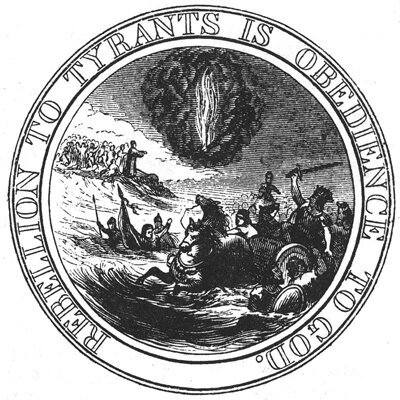 Ben Franklin's proposed design for the Great Seal of the United States included Moses parting the Red Sea.
The first design for the official seal of the United States recommended by Benjamin Franklin, John Adams and Thomas in 1776 depicts the Jews crossing the Red Sea. The motto around the seal read: "Resistance to Tyrants is Obedience to God."
The inscription on the Liberty Bell at Independence Hall in Philadelphia is a direct quote from Leviticus (25:10): "Proclaim liberty throughout the land unto all the inhabitants thereof."
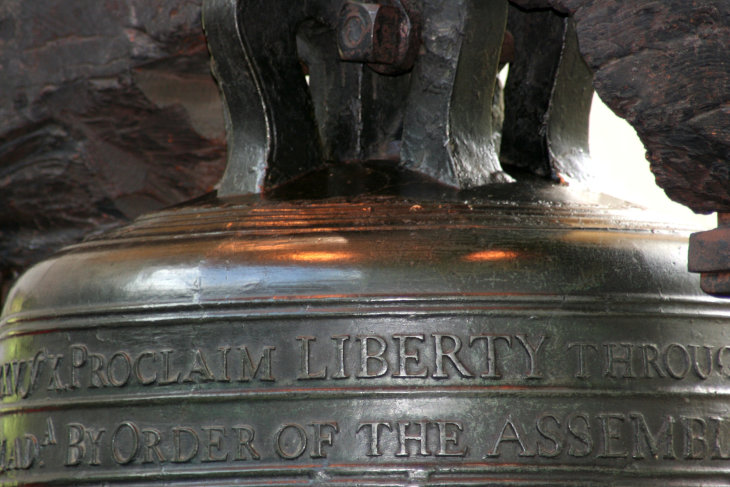 “Proclaim liberty throughout the land”– Inscription on the Liberty Bell.
Patriotic speeches and publications during the period of the struggle for independence were often infused with Biblical motifs and quotations. Even the basic framework of America clearly reflects the influence of the Bible and power of Jewish ideas in shaping the political development of America. Nowhere is this more evident than in the opening sentences of the Declaration of Independence:
"We hold these truths to be self-evident that all men are created equal, that they are endowed by their Creator with certain unalienable rights, that among them are life, liberty and the pursuit of happiness."
Whereas, these words echo the Enlightenment's – specifically John Locke's – idea of "the inalienable rights of man," the concept that these rights come from God is of Biblical origin.
This and the other documents of early America make it clear that the concept of a God-given standard of morality is a central pillar of American democracy. The motto "IN GOD WE TRUST" first appeared on U. S. currency in 1864 and a 1956 Act of Congress (largely passed as a counterforce to communism) made it the official motto if the United States.
U.S. President Woodrow Wilson in his The State acknowledges the impact of the Jews:
“…it would be a mistake…to ascribe to Roman legal conceptions an undivided sway over the development of law and institutions during the Middle Ages… The Laws of Moses as well as the laws of Rome contributed suggestions and impulse to the men and institutions which were to prepare the modern world; and if we could have but eyes to see… we should readily discover how very much besides religion we owe to the Jew.”
Early American Jews
The history of Jews in America begins before the United States was an independent country. The first Jews arrived in America with Columbus in 1492, and we also know that Jews newly-converted to Christianity were among the first Spaniards to arrive in Mexico with Conquistador Hernando Cortez in 1519.
In fact, so many Jewish conversos came to Mexico that the Spanish made a rule precluding anyone who could not prove Catholic ancestry for four generations back from migrating there. Needless to say, the Inquisition soon followed to make sure these Jewish conversos were not really heretics, and burnings at the stake became a regular feature of life in Mexico City.
As for North America, the recorded Jewish history there begins in 1654 with the arrival in New Amsterdam (later to be known as New York) of 23 Jewish refugees from Recife, Brazil (where the Dutch had just lost their possessions to the Portuguese). New Amsterdam was also a Dutch possession, but the governor Peter Stuyvesant did not want them there.
Writes Arthur Hertzberg in The Jews in America (p. 21):
"Two weeks after they landed, Stuyvesant heard the complaint from the local merchants and from the Church that 'the Jews who had arrived would nearly all like to remain here.' Stuyvesant decided to chase them out. Using the usual formulas of religious invective – he called the Jews 'repugnant,' 'deceitful,' and 'enemies and blasphemers of Christ' – Stuyvesant recommended to his directors... 'to require them in a friendly way to depart.'"
The only reasons the Jews were not turned out was that the Dutch West Indian Company, which was heavily depended on Jewish investments, blocked it.
Jews and the American Revolution
By 1776 and the War of Independence, there were an estimated 2,000 (mostly Sephardic) Jews living in America, yet their contribution to the cause was significant. For example, in Charleston, South Carolina, almost every adult Jewish male fought on the side of freedom. In Georgia, the first patriot to be killed was a Jew (Francis Salvador). And additionally, the Jews provided significant financing for the patriots.
The most important of the financiers was Haym Salomon who lent a great deal of money to the Continental Congress. In the last days of the war, Salomon advanced the American government $200,000. He was never paid back and died bankrupt.
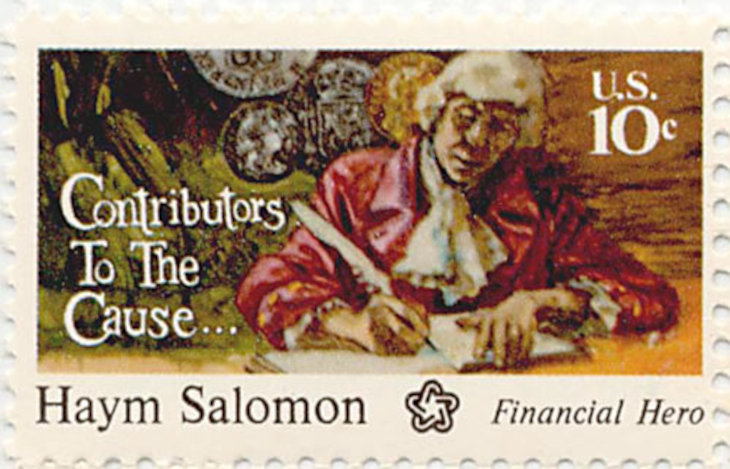
President George Washington remembered the Jewish contribution when the first synagogue opened in Newport, Rhode Island in 1790. (It was called the Touro Synagogue and it was Sephardic.)
He sent this letter, dated August 17, 1790:
"May the children of the stock of Abraham who dwell in the land continue to merit and enjoy the goodwill of the other inhabitants. While everyone shall sit safely under his own vine and fig-tree and there shall be none to make him afraid."
Washington’s reference to the "vine and fig-tree" comes from the words of prophet Micah prophesying the Messianic utopia:
But in the last days it shall come to pass, that the mountain of the house of the Lord shall be established in the top of the mountains, and it shall be exalted above the hills; and people shall flow to it. And many nations shall come, and say, 'Come, and let us go up to the mountain of the Lord, and to the house of the God of Jacob; and he will teach us of his ways, and we will walk in his paths; for Torah shall go forth from Zion, and the word of the Lord from Jerusalem.' And he shall judge between many peoples, and shall decide concerning far away strong nations; and they shall beat their swords into plowshares, and their spears into pruning hooks; nation shall not lift up sword against nation, nor shall they learn war any more. But they shall sit every man under his vine and under his fig-tree; and none shall make them afraid; for the mouth of the Lord of hosts has spoken it.
This was an interesting choice of words on the part of Washington, but, as noted above, it is not surprising in light of the enormous influence that the Hebrew Bible had on the pilgrims and on the founding fathers of the new nation..
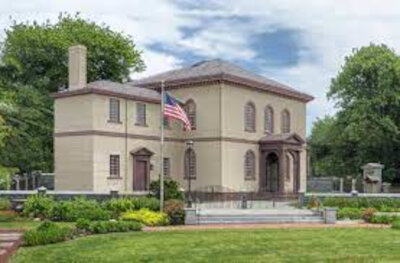 The Touro Synagogue, Newport, Rhode Island.
John Adams, who said some highly complementary things about the Jews, also noted that "it is very hard work to love most of them [the Jews]. And he looked forward to the day when "the asperities and peculiarities of their character" would be worn away and they would become "liberal Unitarian Christians."
The birth of American democracy marks the first time in history that Jewish ethical ideas were legally enshrined into the laws of a non-Jewish nation, contributing to the moral underpinnings of the United States.
The following quote from John Adams, in a letter to F.A. Van Der Kemp, 16 February 1809, is a fitting conclusion:
"... I will insist that the Hebrews have done more to civilize men than any other nation. If I were an atheist and believed in blind eternal fate, I should still believe that fate had ordained the Jews to be the most essential instrument for civilizing the nations. If I were an atheist of another sect... I should still believe that chance had ordered the Jews to preserve and propagate for all mankind the doctrine of a supreme, intelligent, wise almighty sovereign of the universe, which I believe to be the great essential principle of all morality, and consequently of all civilization…
They are the most glorious nation that ever inhabited this earth. The Romans and their Empire were but a bauble in comparison to the Jews. They have given religion to three quarters of the globe and have influenced the affairs of mankind more, and more happily than any other nation, ancient or modern." As quoted in Allan Gould’s What Did They Think of the Jews, (New Jersey, 1997), pp. 71-72.
Click here to download a PDF e-book version of this article.
- Abraham Katsh, The Biblical Heritage of American Democracy, (New York, 1977), p. 97.
- Ibid., 51-72.

No comments:
Post a Comment