One comet to swerve closer to Earth than any other comet in centuries
Monday, followed one day later by a kissing cousin that will swerve closer to the planet than any other comet in nearly 250 years. USAToday
One comet to swerve closer to Earth than any other comet in centuries
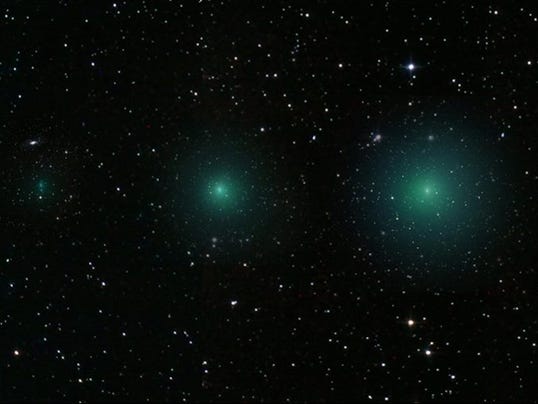
Sporting a surprisingly bright, lovely green coma Comet 252P/Linear poses next to the Large Magellanic Cloud in this southern skyscape. The stack of telephoto exposures was captured on March 16 from Penwortham, South Australia. Recognized as a Jupiter family periodic comet, 252P/Linear will come close to our fair planet on March 21, passing a mere 5.3 million kilometers away. That's about 14 times the Earth-Moon distance. In fact, it is one of two comets that will make remarkably close approaches in the next few days as a much fainter Comet Pan-STARRS (P/2016 BA14) comes within 3.5 million kilometers (9 times the Earth-Moon distance) on March 22. The two have extremely similar orbits, suggesting they may have originally been part of the same comet. Sweeping quickly across the sky because of their proximity to Earth, both comets will soon move into northern skies.
The first and bigger of the two comets will be visible Monday to the naked eye in the southern hemisphere, as long as city lights are far away. Stargazers in the United States will probably need only binoculars to see the bigger comet in late March. Scientists, however, are bringing out the big guns. The Hubble Space Telescope, the powerful ground-based Gemini telescopes and others will be trained on the celestial visitors, which will provide an extraordinary close-up of objects usually glimpsed only at a distance.
Astronomers discovered the trailing member of the pair, P/2016 BA14, a few months ago. It was shrugged off as yet another asteroid, or space rock. Then astronomers peering through a telescope saw it had a tail – and was therefore a comet. That means BA14 and its larger companion “are among the closest comets to pass by Earth in recorded history,” says Knight, who took the first snapshot revealing BA14 is a comet. The only comet known to have skimmed past us at a smaller distance was Lexell’s Comet in 1770.
Read more at link to USA Today above.


No comments:
Post a Comment