PLEASE USE A NAME WHEN COMMENTING

28 April 2023

Rabbi Kahana: Acharai-Kedoshim & Yom HaAtzmaut


BS”D Parashiot Acharai-Kedoshim & Yom HaAtzmaut 5783

by Rabbi Nachman Kahana | Apr 26, 2023


Redemption and Comfort


Yeshayahu 66:12-13

יב: כִּי כֹה אָמַר ההִנְנִי נֹטֶה אֵלֶיהָ כְּנָהָר שָׁלוֹם וּכְנַחַל שׁוֹטֵף כְּבוֹד גּוֹיִם וִינַקְתֶּם עַל צַד תִּנָּשֵׂאוּ וְעַל בִּרְכַּיִם תְּשָׁעֳשָׁעוּ:

יג: כְּאִישׁ אֲשֶׁר אִמּוֹ תְּנַחֲמֶנּוּ כֵּן אָנֹכִי אֲנַחֶמְכֶם וּבִירוּשָׁלִַם תְּנֻחָמוּ

12 For thus says HaShem: I will extend prosperity to her like a river and the wealth of the nations like an overflowing stream, and you shall nurse and be carried on her arm and bounced on her knees.

13 As a mother comforts her child, so I will comfort you; you shall be comforted in Jerusalem.


The Navi (prophet) cites the word comfort three times in one verse. I understand that HaShem’s intention is to bring comfort, solace, cheer, contentment, and inspiration to the exiled Jewish nation by restoring our presence in the holy land and in its spiritual center of Yerushalayim on three different occasions. If so, what are the differences between these three historical episodes of redemption and comfort?


In parashat Bechukotai (Devarim chapter 26:42), the Torah states the paragraphs of the tochacha (reproach, admonition, and exhortation) that set before Am Yisrael, what their fate would be if they sin. Among the verses is the following reaffirmation of the eternal commitment between the Creator and His creations:


וזכרתי את בריתי יעקוב ואף את בריתי יצחק ואף את בריתי אברהם אזכר והארץ אזכר

‘And I shall remember my covenant with Ya’akov, and also my covenant with Yitzchak, and also my covenant with Avraham, and I shall remember the land’.


There are blatant difficulties with this pasuk:

  1. What is the verse reaffirming HaShem’s eternal commitment to Am Yisrael doing in the paragraphs of the threatening tochacha?
  2. Why do the names of the forefathers appear in reverse order rather than the chronological order Avraham, Yitzchak, and Ya’akov?

The theme of this verse is the covenant between HaShem and the Jewish nation, so why is the “land” mentioned, and in such an incidental manner?


I submit:


The word “briti” (my covenant) in this pasuk refers to the sign of the covenant – brit milah (circumcision) imbedded in the flesh of a Jewish male. Avraham’s grandson Ya’akov was born miraculously “mahul” (circumcised), without the need for a surgical act. Avraham’s son Yitzchak experienced a rather ‘conventional’ brit on the eighth day of his life according to the standard halachic requirements.


In contrast to the above, the brit of father Avraham was neither miraculous nor conventional, but rather a painful and even life-threatening procedure that occurred when Avraham was at the advanced age of 99 years old. In parashat Vayeira, HaShem even appears to Avraham on the most painful third day of the brit. Hence, the verse records the three covenants (britot) in the order of their desirability – the miraculous of Ya’akov, the conventional of Yitzchak, and last, the one of Avraham beset with great difficulties and physical pain.


The verse ends with a reference to the “land” (“and I shall remember the land”) which will be similar to the three ‘britot’ of our forefathers, as follows:


The Jews entered Eretz Yisrael three times as a nation.

  1. The first was under the leadership of Yehoshua bin Nun, which transpired through miracles – the crossing of the Jordan River, the victory at Yericho, and subsequent miraculous victories over the following seven years. This entrance to the holy land was parallel to the miraculous covenant of Ya’akov as stated above.
  2. The next time we entered the land was seventy years after the destruction of the First Temple with Ezra and Nechemia who built the Second Temple. This was not a period of miracles, since our return was ratified and endorsed and even initiated internationally through a charter granted to the Jewish nation by Cyrus, King of Persia. This parallels the covenant of Yitzchak, which was performed in the conventional manner.
  3. The third time we returned to Eretz Yisrael is the current historical period, paralleling the covenant with Avraham. He was advanced in years, and we too are an ancient people. It was a very painful experience for Avraham, and our return today is beset with strife and pain.

After 2000 years of wandering in the galut, and after the crucible of the Shoah, and 75 years of statehood, and many wars, one could hope for serenity and peace within Jewish life. However, it appears that HaShem’s agenda for our nation does not stop with a thin strip of land at the eastern end of the Mediterranean Sea.


The destiny of our nation – the only real “manifest destiny” which has ever existed – is the re-establishment of a Torah society within the borders stated in the Torah from the Euphrates to the Nile.  A society governed by Halacha under the Sanhedrin whose seat will be in the Bet Hamikdash, where kohanim and levi’im will serve and the Davidic monarchy is restored.


In such a pure Jewish society, there will be no place for a foreign people who claim ownership or even partnership in the Holy Land.


To return to our original question on the verse in Yeshayahu 66:


יג: כְּאִישׁ אֲשֶׁר אִמּוֹ תְּנַחֲמֶנּוּ כֵּן אָנֹכִי אֲנַחֶמְכֶם וּבִירוּשָׁלִַם תְּנֻחָמוּ

As a mother comforts her child, so I will comfort you; you shall be comforted in Jerusalem.


The Navi (prophet) cites the word ‘comfort’ three times in one verse. What are the differences between these three historical episodes of redemption and comfort, and when did they occur?


Answers: The first “comfort” was when the Jewish nation, led by Yehoshua, entered the land accompanied with fantastic miracles, paralleling the ‘brit’ of Ya’akov.


The second ‘comfort’ was when we returned to the land with Ezra the Scribe to rebuild the second Bet Hamikdash and by permission of two Persian kings, Cyrus and Darius II (Queen Esther’s son), paralleling the brit of Yitzchak.


The third ‘comfort’ parallels Avraham’s brit. We are an ancient people, and after 2000 years of exile to all the world’s latitudes and longitudes, we returned home. 


Despite the fact that we are still struggling to establish our presence here, we are comforted with the knowledge that we are again sovereign over Yerushalayim for the first time in over 2000 years.  It is as the Navi Yeshayahu said, “As a mother comforts her child, so I will comfort you; you shall be comforted in Jerusalem.


Presently, secular media headlines appear in bold red ink; and leftist demonstrators put no limits on their anarchistic conduct, because they are incapable of perceiving HaShem’s intervention in our daily lives. In contrast, HaShem is present in stillness and serenity, as the pasuk (Melachim 1 19:11-12) relates when Eliyahu was on Mount Sinai:


וַיֹּ: אמֶר צֵא וְעָמַדְתָּ בָהָר לִפְנֵי הוְהִנֵּה העֹבֵר וְרוּחַ גְּדוֹלָה וְחָזָק מְפָרֵק הָרִים וּמְשַׁבֵּר סְלָעִים לִפְנֵי הלֹא בָרוּחַ ה וְאַחַר הָרוּחַ רַעַשׁ לֹא בָרַעַשׁ ה

יב: וְאַחַר הָרַעַשׁ אֵשׁ לֹא בָאֵשׁ הוְאַחַר הָאֵשׁ קוֹל דְּמָמָה דַקָּה:

He (HaShem) said, “Go out and stand on the mountain before Me, for I am about to pass”. Now there was a great wind, so strong that it was splitting mountains and breaking rocks in pieces before HaShem, but He was not in the wind, and after the wind a tremor, but He was not in the tremor, and after the tremor a fire, but HaShem was not in the fire, and after the fire a sound of sheer silence…

And then HaShem spoke to Eliyahu from out of the silence.


HaShem has restored us to our Holy Land never to be in galut again. And He will comfort us… “As a mother comforts her child, so I will comfort you; you shall be comforted in Jerusalem”.


In this auspicious week, have a meaningful Day of Remembrance for our holy soldiers who through their sacrifices enable us to live here. And a meaningful Yom Ha’atzmaut for which we have waited 2000 years.


Shabbat Shalom

Nachman Kahana

Copyright © 5783/2023 Nachman Kahana

“Thanking God with Praise and Dancing” – Yom Ha'Atzmaut


Arab Media Slam ‘Provocative Dances’ by Ben-Gvir in Hebron

By Hana Levi Julian


Arab media slammed what they called “provocative dances” by Israeli National 

Security Minister Itamar Ben-Gvir at the Cave of the Patriarchs in Hebron on Wednesday, celebrating Israel’s 75th Independence Day.


On his Twitter page, Ben-Gvir posted a video of his “provocative” dance with Jewish worshipers, saying “Thanking God with praise and dancing in the Cave of the Patriarchs. Happy Independence Day Israel!”


Multiple Arab news outlets also tweeted the footage of Ben-Gvir, who was wearing a tallit and tefillin and dancing in a circle with other likewise attired Jewish men at the sacred site. Muslims refer to the Cave of the Patriarchs as “Abraham’s mosque.”

“Extremist Israeli National Security Minister Itamar Ben-Gvir performed provocative dances in Al-Ibrahemi mosque in occupied West Bank city of Hebron,” the media complained.

A separate Muslim news outlet wrote Ben-Gvir was performing “Talmudic dances.”

One of the Arab news outlets claimed that Ben-Gvir “broke into” the site and danced with “colonial Israeli settlers.”

27 April 2023

Rabbi Kessin – The Secret of Ahavas Yisrael

 A SPIRITUAL AND KABBALISTIC EXPLANATION OF “UNITY” AND WHY AHAVAS YISRAEL


THIS MAKES FOR A NICE COMPANION ON THE SUBJECT OF AHAVAS YISRAEL
 

Rabbi Weissman Halachic Approach: "Love Your Fellow" Explained and Much More

Rabbi Weissman – Reclaiming a Stolen Mitzvah: Love Your Fellow Like Yourself

Yesterday's Torah class was a close look at the fundamental commandment to love your fellow like yourself, followed by some gems from the Midrash.  This mitzvah is commonly misappropriated and reduced to an empty sound bite by those who are neither loving nor adherents of the Torah.  Tune them out and tune into the class here


On that note, here is an article I wrote on the subject three years ago:

https://chananyaweissman.com/article.php?id=172


Reclaiming a stolen mitzvah

One of the most fundamental tenets of Judaism is the mitzvah to love your fellow like yourself. Rabbi Akiva referred to it as a "great rule" in the Torah. When Hillel was asked to distill the entire Torah to a single "sound bite", he cited this mitzvah, and said everything else is commentary.


It is therefore especially tragic that we have allowed this mitzvah to be hijacked, twisted, abused, and corrupted to the point where it has lost all meaning in our time. We have allowed those who are most far removed from the Torah, who in fact wage war against the Torah, to pervert this mitzvah into an empty slogan with which to bludgeon its true practitioners.


For years we have allowed the Torah to be desecrated in our streets – with pride! – with nary a peep of protest. We have allowed ourselves to be convinced that it is pointless to object, even counterproductive, whereby we cleverly turn our unwillingness to stand up for the Torah into a mitzvah for having chosen the prudent course of inaction. Really, we are heroic for doing nothing and saying nothing while everything that is dear to us is desecrated. If we protested for the sake of what is most dear to us we might only legitimize our enemies, or provoke them even further, or make fools of ourselves, so best to look the other way. We believe this because it is convenient, not because it is correct.


We live in a society in which terrorists who make the ultimate sacrifice are referred to as cowards, while those who refrain from fighting back lest they further upset their enemies are called brave, and no one laughs out loud. Declarations of war are now referred to as peace treaties, and casualties of war are referred to as painful sacrifices for the sake of peace. This is the best option, the only option, we are relentlessly told until people believe it or wear down. We allow ourselves to tolerate all manner of hypocrisies and absurdities, for tolerance is the new religion, and everything must be tolerated except what God demands of us. That is what God wants most, we are lectured, to tolerate everyone and everything except for God Himself.


In light of this, it is no wonder that we have allowed the mitzvah to love one's fellow like yourself to become just another painful sacrifice on the altar of tolerance and obfuscation. In the grand scheme of things, this sacrifice doesn't seem to have been all that painful, either. What does it matter anymore? Let it be their mantra.


So now we are lectured relentlessly that those who would make the citizens of Sodom blush and Noach's townsfolk cringe must be loved, as much as we love ourselves. The Torah demands it! It is God's will! If we even harbor a negative thought toward them we are hypocrites, and if we utter it we are criminals, extremists, terrorists who should be locked up before we can strike. Love your fellow like yourself! If you trampled on the Torah, desecrated its very essence, and waged war on God, wouldn't YOU want people to love you and accept you? Of course you would. So you must love others who do the same.


We have even been admonished that this mitzvah extends to actual terrorists, to children of Yishmael who have murdered our people. Those who call for these people to be summarily executed and for the blood of our brothers and sisters to be avenged are silenced with calls to love our fellow like yourself. These murderers were created in the image of God, we are told, just like us, and we must love them, just like ourselves, even if they've been a bit naughty. The Torah demands it. It is God's will. It is a mitzvah.


So preach those who couldn't tell you where this mitzvah appears in the Torah, who couldn't tell you what this mitzvah actually means according to the Sages who transmitted it to us from the day it was given, and who believe all the mitzvos are merely suggestions that can be reinterpreted or done away with according to the needs and desires of the time. This mitzvah, however, is binding on us, it supersedes all others, and it must be taken literally to the most absurd, even suicidal extremes. We must be willing to sacrifice for the Torah, after all, preach those who sacrifice nothing but the Torah.


It is with this lengthy introduction in mind that we must reclaim this mitzvah as our own. We must reaffirm its true meaning and context, both its broad applications and its inviolable boundaries – boundaries which exist for every mitzvah. Those who wage war on the very notion of boundaries shall no longer be permitted to deny the existence of boundaries for this mitzvah too, and in so doing hijack it for their nefarious purposes.

*

The mitzvah to love one's fellow like yourself appears in the beginning of Parshas Kedoshim (19:18), which not coincidentally is preceded by the prohibitions on sexual immorality. The same Torah that commands us to love our fellow also commands us that we are not permitted to express our love – or act out our desires – however we please. One cannot claim one mitzvah is binding, authentic, or otherwise relevant without accepting all the others. The Torah is a package deal.


One who wishes to convert to Judaism and accept upon himself everything except for a single letter of the Torah is denied. A Jew who accepts the divine origin of the entire Torah except for a single letter is a blasphemer. If you want "love your fellow", you must accept every "thou shalt not" as well. If you deny a single "thou shalt not", you have no claim to "love your fellow". If you claim that God wasn't really serious about a single "thou shalt not", then you have no right to impose your strict interpretation of "love your fellow" on anyone else.


If you claim the rabbis made up the laws, it is these same rabbis who emphasized "love your fellow". One cannot cite a rabbinic teaching as support for his lifestyle if he denies the divine authority of these same rabbis and all their other teachings.


Indeed, the next words after "love your fellow like yourself" are "I am Hashem", to teach that we are only commanded to love those who conduct themselves with righteousness and bring honor to Hashem, not those who do the reverse (Torah Temima, Avos D'Rabbi Nasan Chapter 26). Rashbam explains that this mitzvah is limited by the word "your fellow"; we are not commanded to love our enemies or the wicked, only our fellows in goodness and Godliness.


Those who claim that certain mitzvos do not apply to them – nay, that only this mitzvah does apply to them – must be informed that we are only commanded to love our fellows in Torah and fear of Heaven. To the extent that they believe "thou shalt nots" do not apply to them, the mitzvah to love them does not apply to us. Quite the contrary. And we must keep this mitzvah not to love them even though it is extremely difficult for us, and we were born with the gene to love all people no matter what...

*

Considering the importance our rabbis attached to the mitzvah to love one's fellow, it's interesting how little attention is devoted to it in the Gemara and Midrash. We would expect a huge tractate filled with rabbinic teachings on "love your fellow", yet citations of this mitzvah are sparse and appear in the most unlikely of places. This only underscores how the mitzvah is indeed fundamental and the rest of the Torah is commentary, yet it is also just one mitzvah of 613, and it must be compatible with the other 612.


In Sanhedrin we are taught that certain methods of execution in Jewish courts were favored over others that would be even slightly more painful or disgraceful than necessary, due to the mitzvah to "love your fellow like yourself”.


An "enlightened" skeptic would scoff that truly loving one's fellow would be not to execute him altogether, no matter what the crime, for we wouldn't want to be executed no matter what we did. This is nonsense, of course. Loving one's fellow does not mean allowing an entire breakdown of law and justice, especially since that would have devastating consequences for all our other, innocent fellows. It means meting out justice with compassion and empathy even for the lowest of criminals – but meting out justice all the same. Indeed, no system of law in the world demonstrates the degree of compassion and empathy for criminals and sinners to the extent that our Torah does, all while protecting the need for civilization to remain civilized.

*

The truth is that the commandment to love another person just as one loves himself, taken literally, is absurd. Not only is it absurd, it goes against the Torah. If one is traveling in the desert with a fellow Jew, and he has only enough food and water for one person to survive, he must keep it for himself. It is also prohibited for a person to give away too much of his own money to charity lest he become destitute in his own right. Self-sacrifice has its limits, and a literal interpretation of "love your fellow like yourself" is incompatible with the Torah's actual position. But of course.


That said, we also know that the most basic meaning of a pasuk, the peshat, cannot be disregarded. The Ramban explains that the mitzvah to love one's fellow equally to himself refers to the obligation to desire only the very best for one's fellow Jew in all matters, just as one wishes for himself. This mitzvah single-handedly drives away petty competition, ayin hara, jealousy, the begrudging reactions people often have when others find success, especially in areas where one is lacking. Why him and not me? The mitzvah to love one's fellow like himself urges us to wish only good things for our fellow Jews and to be genuinely happy for them when they find success. To truly love someone is to view their success with satisfaction, as if it were your own.


Needless to say, nowhere in Torah literature will one find in this mitzvah a license to condone evildoing or pardon willful, unrepentant sinners. To do so demonstrates neither love for the other person, nor for yourself, nor for society, nor for the Torah, nor for God. If one is struggling with a particular commandment and truly wishes to perform God's will, he will receive boundless love and support from His people. Even if he stumbles along the way, he remains "our fellow" so long as he accepts the commandment as binding and wishes to fulfill it. Such a person is truly "our fellow", for he is all of us, and we shall love such a person just as we love ourselves.


If, however, someone claims that a commandment is not binding, or not relevant, or fabricated by corrupt Talmudic personalities, or simply doesn't apply to him, then he has excused himself from the fellowship, and is no longer entitled to the privileges of membership. The very preceding pasuk to "love your fellow" is the commandment to rebuke a fellow Jew – which, like every other mitzvah, must be done within proper parameters, but which is a mitzvah just the same.


Even before we are commanded to love a fellow Jew, and immediately after we are commanded not to hate a fellow Jew, we are commanded to rebuke a sinner. This is part and parcel of the loving relationship we are supposed to share with one another. A relationship in which "love" means a blank check to do whatever one desires and receive only approval in return is neither a loving relationship nor a healthy relationship. It is certainly not mandated by the Torah.


The first pasuk of Shema, the most basic of Jewish prayers, commands us to love Hashem with all our hearts, all our souls, and all that we possess. Let us love Hashem, let us love those who serve Him, and let us love those who wish to serve Him even if they are still on the beginning of the road. But they must be on that road, not seeking to blow it up. They must be our fellows.


None of what I have written here is novel. Unfortunately, due to the onslaught of "love your fellow" by those who make a farce of this and all other mitzvos, we need to review that which we already know and strengthen our commitment to it. Let us reclaim this mitzvah as the exclusive inheritance of those who accept the Torah – the entire Torah – and let us proclaim its true meaning with pride.

True Jewish pride.


__________________________

chananyaweissman.com/

rumble.com/c/c-782463

Download Tovim Ha-Shenayim as a PDF for free!


If you received this from someone else and want to receive future articles directly, please send a request to endthemadness@gmail.com.


 For those who have short memories and easily slip back into useful idiot mode:


Tonite, Thursday 7:00 pm, April 27, Million People Protest

 Kaplan Street, Jerusalem, Across from the Knesset


Thursday Night 7:00 PM, April 27, 2023 . . .Will Be a Statement of Urgency


With all due respect to the “position” the person pushing a sappy agreement is totally off-base and showing disrespect for the duly elected government and the G-d of the Nation of Yehudim. And the PM is attempting to reduce (compromise) the position of Yariv Levin. This cannot be overlooked.

President Itzhak Herzog’s staff told Reshet Bet Radio on Thursday that if the negotiations being hosted at the presidential residence do not come to a conclusion soon, they would be forced to set a deadline for the talks.

Mind you, this is the same staff that talked the president into dropping several reasonable suggestions for a solution Herzog had accepted from prestigious left- and right-affiliated academics who collaborated for the sake of national unity, offering instead a disappointing, one-sided, anti-government proposal Herzog had the audacity to present as a compromise where “everybody wins.”

According to the report, the president’s patience will be exhausted in a few weeks, should the folks who call the legislation “judicial reform” and those who prefer “coup d’état” not reach a compromise.

Also on Thursday: one million right-wing voters are urged to show up in front of the Knesset to drive home the fact that the majority of Israelis want the judicial reform pretty much as it was presented by Justice Minister Yariv Levin back in the days when the only fault the anarchist left could point out in the government was appointing Avi Maoz.


According to Kan 11 News, the two sides have reached a compromise on the process of enacting constitutional legislation, known as Basic Laws. Justice Aharon Barak, leader of the judicial revolution in the early 1990s that empowered the Supreme Court over the other two branches of government, suggested there was no difference between a basic law and a regular law, other than the fact that the former had the words “basic Law” in the title. As it turned out, this cavalier attitude goes against the constitutional instincts of many Israelis on both sides of the aisle.

There’s a reason why parliamentary systems the world over insist that enacting or amending constitutional legislation should require a longer and more involved process than common legislation. While everyday laws may be used by the courts to establish precedence through their interpretation, constitutional laws block judicial interpretation, forcing the judges to obey them as they are or come up with astonishingly inventive ways to sidestep them.

And so, while Israeli voters have no problem recognizing the right of government to govern by whatever size majority it manages to put together, the same voters’ constitutional instinct suggests that basic laws should be harder to enact. The anti-reform protests are indeed being manipulated skillfully by a surprisingly small group of anarchists, but, at the same time, the average Israelis’ constitutional instinct is the reason they can be persuaded to come out to the streets.

The reported compromise requires a fourth plenum vote and a bigger majority to approve basic laws. In other words, the coalition, which presumably won the third plenum vote after the basic law had come out of committee, would have to gather additional support, this time from opposition parties, which would necessarily mean additional amendments.

Sounds too difficult? Consider this: Article V of the US Constitution provides two ways to propose amendments to the Constitution. 1. Amendments may be proposed either by Congress, through a joint resolution passed by a two-thirds vote, or, 2. By a convention called by Congress in response to applications from two-thirds of the state legislatures.

It makes the Israeli compromise look in comparison, what’s the legal term, easy-peasy?

Meanwhile, no progress has been reported on the makeup of the committee to elect judges. Justice Minister Yariv Levin insists it must be changed, the lawyers must be kept out, and the coalition should be granted an advantage in at least some of the judicial appointments. Levin told Reshet Bet Radio on Thursday morning that if the committee is not changed, he won’t convene it, effectively freezing new nominations to the Supreme Court. Considering the fact that Court President Esther Hayut is scheduled to retire in October, Yariv’s threat is extremely real.

By law, Hayut will be replaced by her deputy, Justice Uzi Vogelman. He announced earlier that he prefers not to succeed Justice Hayut, and the post was going to go to Justice Yitzhak Amit, but now it’s not clear if Vogelman is allowed to decline the job. In any event, if court appointments are frozen, the supremes would be down to 14 judges in October, and 13 in October 2024, when Vogelman retires.

Now, that’s how a senior politician should operate, and more power to Yariv Levin for using his power to fight the man (or woman, in this case). One question remains: if you’re this good at using your power, how come you succumbed to pressure and didn’t pass the first item of the judicial reform by the end of the winter session after it had come out of committee all shiny and bright and ready to be passed by a 64-vote majority?

The answer is as it has been since 1996 in Israel’s right-wing politics: Bibi. The fact is, Prime Minister Benjamin Netanyahu never wanted judicial reform, hardly mentioned it during his 2022 campaign, and did nothing to support Justice Minister Yariv Levin and Constitution Committee Chairman MK Simcha Rothman in their struggle against a hostile media, poisonous media, fifth-column police department, lawless trade union, crypto-fascistic subversives in all areas of Israeli public life, and even within the Likud party.

It was Bibi who killed the reform vote in late March, and it’s Bibi who will be cutting its oxygen in the months to come. If not for Bibi’s preconceived retreat, we wouldn’t have needed the negotiations, the reform would have been behind us, and whoever still wanted to demonstrate could demonstrate.

And this is the reason Levin has been urging right-winger to show up for the million-person march on the Knesset Thursday evening. He, and every last right-winger, know this rally is directed only at one person.

“Vandals” in Jerusalem – Guess Who Done it?


Vandals Rip Out Dozens of Mezuzahs in Jerusalem Luxury Neighborhood

By David Israel


Dozens of mezuzahs were systematically torn off the front doors of entire buildings in the luxurious Talbiye neighborhood of Jerusalem, and to date, no suspects have been found, Srugim reported Wednesday.

What appeared at first as isolated incidents, turned out to be a widespread attack on dozens of homes on Washington and Lincoln streets, as well as the main streets of King George and Keren Ha’Yessod, according to Srugim. Despite its network of security cameras, as befits a prestigious neighborhood near the Prime Minister’s official residence on Balfour Street, Police still have no clue who done it.

A student named Aviad told Srugim: “I woke up this morning and realized that the mezuzah was not on the door. When I left the house, one of the neighbors asked if there was any chance that my mezuzah had also dropped. I went through the entire building and realized that this is a widespread phenomenon of tearing off mezuzahs.”

Aviad posted in the neighborhood’s WhatsApp and Facebook groups and received many responses from residents who discovered that this was widespread vandalism. “I contacted the police, and they said I should come to report at the station, but after many residents had reported by phone, the police arrived to investigate, but have no findings yet.”

Talbiye may be a luxurious neighborhood, but many residents are students who share apartments, and, naturally, lobbies are more easily accessible and security is laxer.

Vandalism involving ripping out mezuzahs is usually associated with antisemites abroad. In Israel, hostility to religious Jewish symbols is characteristic of the left, which has recently increased its campaign against religious coercion, a.k.a. “hadata,” loosely translated as “making religious.”

https://www.jewishpress.com/news/police-news/vandals-rip-out-dozens-of-mezuzahs-in-jerusalem-luxury-neighborhood/2023/04/27/

Screenshot of Muzuzah from https://www.alonijewelry.com/shop/judaica/shaddai-mezuzah/

Spiritual Tools for Israel’s Military Might


Spiritual Tools for Israel’s Military Might


Today we celebrate Yom Ha’Atzmaut, the modern State of Israel’s Independence Day, which immediately follows Yom HaZikaron, when we commemorate those who have given their lives for Israel. Each one of those lost is an indescribable tragedy. Though Israel has won the majority of its wars, the price has been devastatingly high. We know that what happens in this material world is often just a reflection of higher realities occurring in the spiritual worlds. With that in mind, what can we all do spiritually to affect the worlds above, in order to strengthen Israel militarily here below? The Torah gives us four major tools that a Jew can do that will go a long way in boosting Israel’s might and, G–d willing, reducing casualties in war.

The first of these tools comes from this week’s parasha, Acharei Mot, which spends many lines describing the Yom Kippur service. Commenting on one of the verses here (Leviticus 16:12), the Ba’al HaTurim (Rabbi Yakov ben Asher, 1269-1340) points out that “in the merit of the Yom Kippur service, [the Israelites] would win wars.” Although we do not have a Temple today to fulfill all of the services, nonetheless our heartfelt prayers and repentance on Yom Kippur affect a change in the Heavens that result in Israel becoming militarily stronger and victorious in war.

We see a perfect demonstration of this in the 1973 Yom Kippur War, when Israel was surprise-attacked by its Arab neighbours, totally unprepared and with most of its soldiers in the synagogues. The war initially went very badly, and military analysts even predicted the impending demise of Israel. Yet, things turned around quickly, and just two weeks later the war ended with a resounding victory for Israel. Henceforth, the Arabs never tried another invasion, and Egypt—the leading power in the Arab world—gave up any goals of destroying Israel, instead pursuing peace. The Arab armies thought that by attacking Israel on Yom Kippur they had a big advantage. The reality was the exact opposite! In the merit of Yom Kippur, Israel won the war and permanently altered the geopolitical landscape in the Middle East.


Six years earlier, before the similarly miraculous Six-Day War, the Lubavitcher Rebbe instituted another campaign to strengthen Israel militarily: encouraging the donning of tefillin. Ever since, Chabadnikim around the world go to street corners, supermarkets, bus stops and other public places to encourage Jewish men to wrap. Various reasons have been given for why the Rebbe chose tefillin specifically as a way to strengthen Israel. The main one is based on a passage in the Talmud (Rosh Hashanah 17a). Here, the Sages discuss an End of Days prophecy in Zechariah which states a third of the population will be purified “by fire”. The Sages say these are the rebellious people who sinned with their bodies. The Talmud further defines that when it comes to the gentiles, the ones who sinned with their bodies are those who engaged in sexual sins. When it comes to Jews, however, it refers to those who never put tefillin on their bodies!

Based on this, the Rebbe saw that there is tremendous merit in donning tefillin, and puts a Jew into a wholly different spiritual category once he has done so, even just once. Moreover, since the verse in Zechariah is talking about an End of Days prophecy about the final apocalyptic war before Mashiach’s arrival, the Rebbe saw further significance to our day and age, hence the message that we should increase the observance of tefillin. Indeed, the tefillin campaign was a huge success, as was Israel’s subsequent Six-Day War, with huge implications for the coming of Mashiach, since this is when Jerusalem and the Jewish heartland of Judea and Samaria were reclaimed and liberated.

I believe there is another proof for the tefillin-military might connection: In Berakhot 57a, we read that a person who dreams of himself in tefillin should expect greatness. This is based on Deuteronomy 28:10 which reads: “And all the peoples of the earth shall see that the name of G–d is called upon you; and they shall be afraid of you.” The Sages ask: what does it mean to have the “name of G–d” upon you? It means putting on tefillin, since this is when G–d’s Name is literally wrapped upon a person’s body! And, when the gentiles see a Jew in tefillin, it inspires a sense of awe and fear among them. So, just as Deuteronomy promises, when the Jewish nation carefully and diligently dons tefillin, it will inspire fear in our enemies.

Another segulah for reducing Israel’s casualties on the frontlines and beyond is the mitzvah of charity. This one is well-known and needs little elaboration, since the Tanakh emphatically states that tzedakah tatzil mimavet, “charity saves from death” (Proverbs 10:2). As explained in detail elsewhere (see ‘How Charity Can Save Your Life’ in Garments of Light, Volume One), providing a financial contribution to a worthy cause affects a change in the Heavens that can tear up a decree hanging over a person’s soul. This is because the money one earns is tied directly to the exertion they put in to earn that money, since a person invests their time, energy, and soul into their work. The Torah tells us that giving even a half-shekel serves as kofer nefesh, an atonement for the soul (Exodus 30:12). There is a beautiful mathematical proof to this in that the words shekel (שקל) and nefesh (נפש) have the same numerical value (430)!

Finally, the Torah states that if we are worthy, “Five of you shall chase away a hundred, and a hundred of you shall chase away ten thousand; your enemies shall fall before you by the sword.” (Leviticus 26:8) A classic question here is regarding the ratios: five chasing away a hundred is a ratio of 1 to 20, but a hundred chasing away ten thousand is a ratio of 1 to 100! What we can learn from this is that the more Jews are united and fighting together, the stronger we become. That strength does not just grow linearly, but exponentially! The message is that we must all be united. Instead of sinat hinam, baseless hatred and enmity, we must have ahavat hinam, baseless love and unity. This is our greatest source of strength.

Putting it all together, we have four key tools to increase Israel’s military and physical might: Yom Kippur, tefillin, tzedakah, and ahava. Amazingly, if we take the initials* of these terms (י כ ת צ א), they spell out כי תצא, as in כִּֽי־תֵצֵ֥א לַמִּלְחָמָ֖ה עַל־אֹיְבֶ֑יךָ וּנְתָנ֞וֹ יְהֹוָ֧ה אֱלֹהֶ֛יךָ בְּיָדֶ֖ךָ, “When you go out to war against your enemies and G–d will deliver them into your hand…” (Deuteronomy 21:10) There is no better proof than this that if we increase our observance of these crucial mitzvot as a nation, we will undoubtedly be invincible, and G–d will deliver all of our enemies into our hands.

Yom Ha’Atzmaut Sameach!


*If we take only the first initials of the four mitzvot above (without the kaf of kippur), we have יתצ״א, which carries a value of 501. This is a very significant number, too. At the Pesach seder, we group the Ten Plagues by their initials and recite דצ״ך עד״ש באח״ב. The great kabbalist Rav Shimshon of Ostropoli (d. 1648) taught that the value of this phrase is 501, equivalent to an angel named תק״א that facilitated the plagues and punished the enemies of Israel. Additionally, this is reminiscent of the “Angel of G–d” that struck down the Assyrian camp of 185,000 soldiers to protect Jerusalem in the time of King Hezekiah (II Kings 19:35). 


https://www.mayimachronim.com/spiritual-tools-for-israels-military-might/

Mayim – The Kabbalah of Yom Ha‘Atzmaut

 The Kabbalah of Yom Ha‘Atzmaut

This Wednesday, the 5th of Iyar, is Israel’s Independence Day, Yom Ha‘Atzmaut. That the State of Israel was born on this date in particular is no coincidence. On the surface, the reason it happened on this date is because that was when the British Mandate expired, and was the earliest opportunity for the Zionist leadership to declare independence. Behind this, however, there is a far deeper mystical reason.

Back in the 18th century, the Vilna Gaon (Rabbi Eliyahu Kramer, 1720-1797), one of the greatest kabbalists in history, taught that the time had come for Jews to return to their Promised Land. He devoted the last years of his life towards making this a reality. The Vilna Gaon attempted to make the journey himself, but was unable to complete it. He instructed his students do so, and they did, in three waves. The first wave of Perushim (“separated ones”, as they called themselves) was led by Rabbi Menachem Mendel of Shklov. When they got to Israel, they discovered they could not settle in Jerusalem because a ban had been placed on Ashkenazi immigration by the Ottoman authorities. The ban came as a result of an earlier group of Ashkenazis that had journeyed there, led by Rabbi Yehuda haHasid Segal (c. 1660-1700, not to be confused with the 12th century Rabbi Yehuda haHasid of Regensburg, and not to be confused with rabbis of the later Hasidic movement).

Rabbi Yehuda haHasid was another kabbalist who fervently sought to get Jews back to Israel and launch the Redemption. In 1697, together with 31 other families, Rabbi Yehuda set forth from Poland towards the Holy Land. Along the way, he successfully convinced some 1500 Jews to come with him (not all of them made it). To get there, Rabbi Yehuda and his group had to bribe many Ottoman officials, taking on large debts. They arrived in Jerusalem to find an impoverished Jewish community of about 1000 Sephardis and 200 Ashkenazis. Their arrival instantly doubled the Jewish population, and was a huge strain on the community who didn’t have the resources to help them.

Rabbi Yehuda himself died within days of arrival. His followers started building a synagogue of their own—in his name—on the site of an earlier synagogue from the 15th century. (That earlier synagogue had, in turn, been built upon an even earlier synagogue thought to have belonged to Rabbi Yehuda HaNasi in the 2nd century. In 2003, archaeologists digging there discovered three ancient mikvehs dating back to the 1st century!) Rabbi Yehuda haHasid’s followers ended up taking on many more debts from the Ottomans and Arabs to finance their construction. When they couldn’t repay their debts, a band of Arabs burned down the synagogue in 1720. The Ottoman authorities then banned all Ashkenazis from Jerusalem, blaming them for all the recent ills that had befallen the community.

Due to this ban, Rabbi Menachem Mendel’s group settled in Tzfat. There they encountered some of the disciples of another Rabbi Menachem Mendel (of Vitebsk, c. 1730-1788). This rabbi was one of the early Hasidic leaders, a disciple of the Maggid (Rabbi Dov Ber of Mezeritch, c. 1704-1772, who was the disciple of the Baal Shem Tov, founder of the Hasidic movement), and a close friend of Rabbi Schneur Zalman of Liadi (1745-1812, founder of Chabad). In 1777, Rabbi Menachem Mendel of Vitebsk brought a group of 300 Jews to Israel. They also had to settle in Tzfat since the door to Jerusalem was closed. Several years later, most of his group was forced out of Tzfat and moved to Tiberias. Others dressed up as Sephardis and succeeded in settling in Jerusalem.


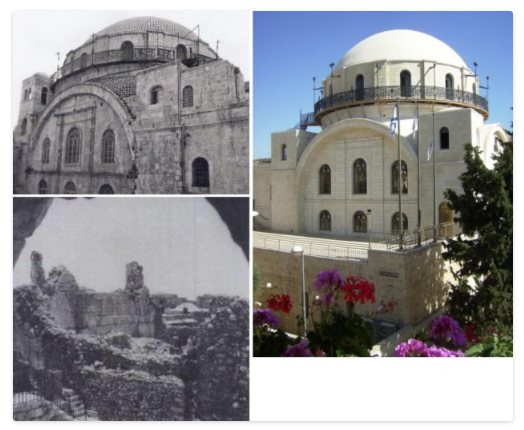
Top left: the Hurva Synagogue in 1930; bottom left: the ruins in 1967; right: the Hurva today (photo credit: Chesdovi). After many years of struggles, Sir Moses Montefiore intervened and got the Perushim the permission (and funds) they needed to start rebuilding the synagogue. More than half of the money for construction came from the wealthy Iraqi-Jewish family of Ezekiel Reuben. The synagogue was completed in 1864 and originally called Beit Yakov in honour of Edmond James (Yakov) de Rothschild. It was considered the most beautiful building in Jerusalem, and nicknamed “the glory of the Old City”. The Arabs destroyed it in 1948 during the Independence War. Israel reclaimed it with the reunification of Jerusalem in 1967. The synagogue was rebuilt, more beautiful than ever, and reopened in March 2010. Two months later I came to Jerusalem to study in yeshiva and prayed shacharit there each morning!

Rabbi Menachem Mendel of Shklov (the disciple of the Vilna Gaon, that is) and his group didn’t stay in Tzfat very long. Eventually, they managed to get permission to settle in Jerusalem, and started reviving its Ashkenazi community. They took on the project of rebuilding the synagogue of Rabbi Yehuda haHasid, which was still lying in ruins. They saw this as a symbolic mission that represented the first step in rebuilding all of Jerusalem. The day that they arrived in the Holy City, as well as the day on which they began rebuilding what was known as the Hurva Synagogue (hurva meaning “ruins”), was the 5th of Iyar. This was also the day that they established Beit Midrash Eliyahu, a yeshiva named in honour of their master, the Vilna Gaon.


The lower 7 sefirot correspond to the 7 Shepherds of Israel


The Perushim chose this date in particular because the Vilna Gaon had taught that this was the most auspicious day to start the process of Redemption. The prophet Ovadiah had said that one day the flame of the “House of Jacob” and the “House of Joseph” would be reignited, and burn up its enemies, and re-inherit the land that was rightfully theirs (Ovadiah 1:17-18, see also Psalms 77:16). On a mystical level, as is well-known, Jacob represents the sefirah of Tiferet, while Joseph represents the sefirah of Yesod. Thus, the opportune time to begin rebuilding Israel was when these two sefirot meet: the day of Yesod sh’b’Tiferet, which is the 5th of Iyar.

[For those who need a little more background: The period between Pesach and Shavuot is the time of Sefirat haOmer. This is when we recite a special count for each day of the seven-week period. On a kabbalistic level, the purpose of this time is to rectify the seven major middot or character traits, corresponding to the seven lower mystical sefirot (see: The Spiritual Significance of Sefirat HaOmer). Each of the seven weeks parallels one trait, and each of the seven days within each week also parallels one of the traits. The sixth day of each week is for the sixth sefirah, Yesod, while the third week is for the third sefirah, Tiferet. Therefore, the day of Yesod sh’b’Tiferet is where these two sefirot meet, which is the 20th day of the Omer, always falling on the 5th of Iyar.]

In kabbalistic texts, the land of Israel is associated with the sefirah of Tiferet. (The Jewish people, too, are rooted in this same sefirah.) Meanwhile, Yesod means “foundation”, and sits at the very bottom of the “male” qualities of the sefirot. It really is the “foundation” of the sefirot, and the most important one in attaining true righteousness and holiness. This is why Joseph—who embodies Yesod—is the only Biblical figure to be given the title HaTzadik, “the righteous one”. Yesod sits right before the final sefirah of Malkhut, “Kingdom”, representing the final messianic era. Therefore, the only thing standing in the way of Redemption is the rectification of Yesod.

The mystics teach that the final generation before Mashiach comes will be faced with the greatest test: repairing Yesod. All the other rectifications have already been completed by earlier generations. (The Arizal taught that there are a total of 288 such rectifications, a number we will come back to.) And so, the Vilna Gaon saw within the 20th day of the Omer—Yesod sh’b’Tiferet—the perfect time to start the final process of rectification.

On a mystical level, Yesod sh’b’Tiferet can literally be read as “Foundation in the land of Israel”. This is why the Vilna Gaon’s disciples made it a point to establish their work on this day. And this is why, not coincidentally, it would turn out that the British Mandate would expire on this day, and on this day in the Holy Land the Jewish people would declare an independent state for the first time in over two thousand years.

The 50 Gates and the Revival of Israel

Each of the fifty days between Pesach and Shavuot also corresponds to the mystical 50 Gates of Understanding, Nun Sha’arei Binah. (Over the past several years, I’ve been working on a book to explain each of these gates, and how they correspond to the sefirot and the days of the Omer, among other things. Stay tuned!) The 20th day of the Omer parallels the 20th gate. While there is some variation in the naming of these gates, the text that is most frequently used (and appears in some Havdalah prayers, as well as in the “Great Kaddish” recited by Sephardis during the High Holidays) lists the 20th gate as tal u’matar livracha, “dew and rain for blessing”.

This is the gate that is most connected to the land of Israel, as we pray daily for G–d to bless the land of Israel with  abundant dew and rain. The Torah makes it clear that Israel is a unique land, the survival of which is entirely dependent on rain (Deuteronomy 11:10-11). Unlike the neighbouring lands of Egypt and Babylon—which rely simply on periodic flood cycles of their great rivers—Israel has no water without rain from Heaven. G–d did this on purpose so that the Jewish people would pray to Him for sustenance, and not rely on nature alone. The general word for rain, geshem, shares a root with gashmiut, “physicality” and “materialism”, for the Jew is meant to see all of his material wealth as “raining down” from G–d.

Reviving the land of Israel means bringing down the dew and rain upon it once more. For the soil to flourish and bring forth produce, Israel needs rain. The Sages state (Sanhedrin 98a) that the greatest sign of the Redemption is when Israel becomes an agricultural marvel once again, producing an abundance of fruit that is enough both for itself and for export, as prophesied by Ezekiel: “But you, O mountains of Israel, you shall shoot forth your branches, and yield your fruit to my people of Israel, for they are at hand to come.” (Ezekiel 36:8) And also prophesied by Isaiah: “In days to come, Jacob will take root, Israel will bud and blossom and fill all the world with its fruit.” (Isaiah 27:6) Needless to say, we are living this reality today, where Israel has recently reached self-sufficient status (meaning its citizens will not starve if all food imports are stopped) and now exports nearly $2 billion of food every year.

Therefore, the 5th of Iyar takes on even more significance, as it is the day that the Heavenly “gates of dew and rain for blessing” can be opened. Miraculously, this has happened for Israel, which has been blessed with incredible abundance. We have seen Isaiah’s prophecy fulfilled before our eyes: “The wilderness and the parched land shall be glad; and the desert shall rejoice, and blossom as the rose. It shall blossom abundantly, and rejoice…” (Isaiah 35:1-2)

The realization of this prophecy is a sign that the rectifications are nearly complete. (For those who like numbers, the gematria of tal and matar is 288, that value which represents the totality of rectifications.) Ezekiel told us that Israel would first experience a horrible catastrophe, then return to the Holy Land “from the sword” and rebuild a prosperous state:

in the End of Years you shall come against the land that is brought back from the sword, that is gathered out of many peoples, against the mountains of Israel, which have been a continual waste; but it is brought forth out of the peoples, and they dwell safely all of them… to turn your hand against the waste places that are now inhabited, and against the people that are gathered out of the nations, that have gotten cattle and goods, that dwell in the middle of the earth. (Ezekiel 38:8-12)

In his Ma’amar HaGeulah, “Discourse on the Redemption”, the Ramchal (Rabbi Moshe Chaim Luzzatto, 1707-1746) explains that there are two stages to the Redemption: Pekidah and Zechirah. One will be a long process, and the other a quick one, though both involve great spiritual rectifications. Fittingly, the Ramchal says that the Pekidah stage is in the sefirah of Yesod, and the Zechirah stage is in the sefirah of Tiferet (ch. 21), once again showing us the importance of Yesod sh’b’Tiferet in the process of Redemption.

One of the Ramchal’s primary sources is a well-known passage in the Zohar (Ma’amar Derakh Kokhav miYaakov in Zohar Chadash on Balak), where it says that the preparatory period before Mashiach, or the “birth pangs” of the messiah, will take 70 years (partly based on Psalm 20, which has 70 words). This 70-year period corresponds to the lengthy first stage of Redemption. We should be especially mindful of this as the State of Israel turns 72 [75] this week. The stage is set.

Yom Ha‘Atzmaut Sameach!

https://www.mayimachronim.com/the-kabbalah-of-yom-haatzmaut/

Hi! HAPPY HAPPY BIRTHDAY!